H-1B Visa Stamping in South Korea 2026: Seoul Embassy Guide, Wait Times, and Documents
South Korea is one of the fastest H-1B stamping destinations in 2026 — here is exactly how to get your visa stamp in Seoul with minimal delay.
Part of our guide to H-1B visa stamping.
Updated for 2026 — check this before you book anything. The State Department now directs nonimmigrant visa applicants to apply in their country of nationality or legal residence, so third-country stamping is no longer generally available as a way around a backlog. H-1B applicants are also reported to no longer qualify for the dropbox interview waiver, meaning an in-person interview is required including for renewals. Appointment availability has tightened sharply in several countries. Parts of this article were written before those changes. Confirm the current rules on the official booking portal and with an immigration attorney before making travel plans — see why third-country H-1B stamping is no longer an option.
You have an approved H-1B petition, your I-797 is in hand, and your passport needs a fresh visa stamp before you can re-enter the United States. If you are reading this from South Korea — whether you live here, are visiting family, or flew here specifically to get stamped — you are in one of the best positions possible. Seoul's US Embassy has maintained appointment availability that routinely beats most other major posts by weeks or months, and administrative processing rates for straightforward tech-sector cases have been lower here than at higher-volume locations.
This guide covers exactly what you need to do to get your H-1B stamp at the US Embassy in Seoul in 2026 — the appointment booking process, the full documents checklist, what to expect on interview day, how to handle administrative processing if it happens, and the common mistakes that cause unnecessary delays.
Why Seoul Is Worth Considering for H-1B Stamping
Most H-1B holders default to stamping in their home country. If your home is India, that means Chennai, Mumbai, Hyderabad, or New Delhi — posts currently running appointment wait times of several months and, in some periods, longer than a year. If you have any legitimate reason to be in South Korea — a work trip, a family visit, a conference — stamping here instead can cut your total wait from months to weeks.
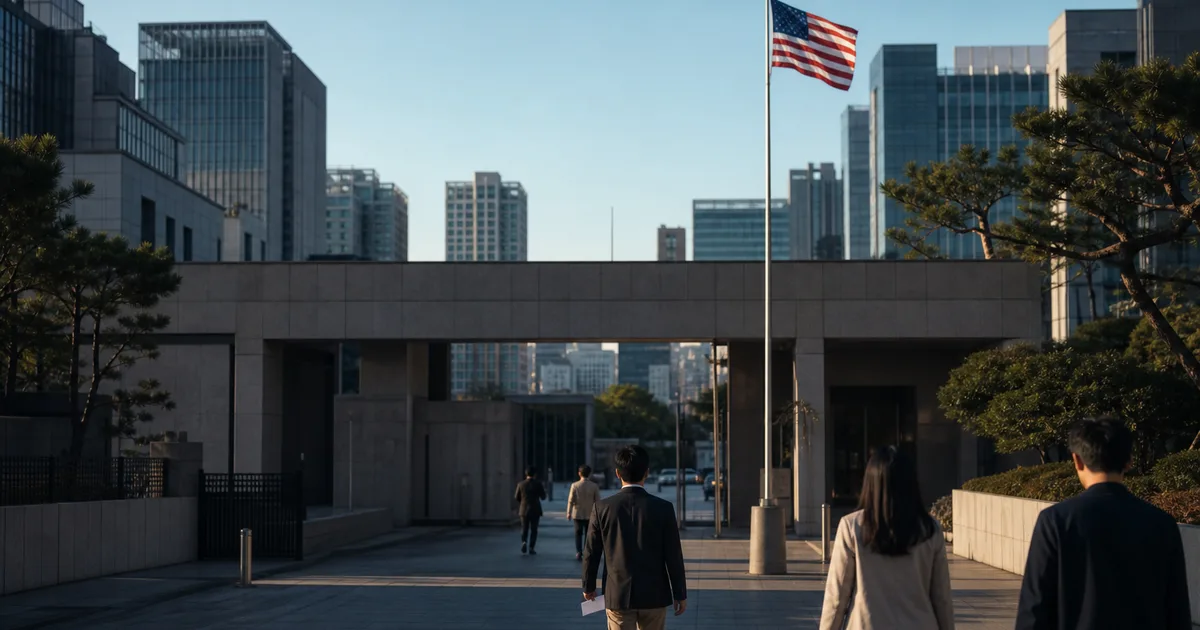
The Seoul post at Sejong-daero is a mid-volume location by global standards. It handles Korean nationals, third-country nationals with valid long-term Korean status, and certain diplomatic appointments. The visa category processing infrastructure for non-immigrant categories like H-1B is efficient, and the post does not face the same structural capacity constraints as Chennai or Mumbai.
For context, see our H-1B stamping India 2026 guide to understand what you are avoiding when you stamp elsewhere, and our H1B1 visa guide for Singapore and Chile if you are exploring other fast-turnaround stamping locations.
Eligibility for Third-Country Stamping in Seoul
You do not need to be a South Korean citizen to stamp here. The consular discretion principle means the officer can approve or deny a third-country stamping request, but in practice, the following categories are routinely accepted:
- Korean citizens and permanent residents (F-5 visa holders)
- Holders of valid Korean work visas (E-1 through E-9 categories)
- Holders of valid Korean long-stay visas (D-category student visas, F-category family visas)
- Spouses of Korean nationals with valid residency
If you are in Korea on a short-stay tourist entry (K-ETA or visa-free), it is generally discouraged to attempt third-country stamping — officers expect you to have a substantive reason for being in country and a legitimate stay category. Check the embassy's official third-country national guidance at travel.state.gov before booking.
Step-by-Step Appointment Process
1. Pay the MRV Visa Application Fee
Before booking an appointment, you need to pay the Machine Readable Visa (MRV) fee — currently $205 for H-1B category petitions. Payment is made through the Korea-specific payment portal at the CGI Federal system (ustraveldocs.com/kr or the current successor site). Keep the receipt; you will need the reference number to book your appointment.
2. Complete the DS-160 Online
Fill out the DS-160 at ceac.state.gov. Use exactly the name on your passport. Your employer and their immigration counsel should review this form — errors in the DS-160 are a leading source of avoidable complications. Print the confirmation barcode page when you submit.
3. Book the Appointment
Log into the CGI Federal appointment portal and select Seoul as your post. As of early 2026, H-1B interview appointments at Seoul have been available within approximately 1-4 weeks. Select both the visa interview appointment and, if applicable, an off-site document submission appointment (the Seoul post's process for this may vary — check current instructions at the time of booking).
4. Prepare Your Documents (see full checklist below)
Gather everything in the checklist section. Do not assume the officer will accept missing documents and sort it out later — incomplete documentation is one of the most common reasons for 221g administrative processing refusals.
5. Attend the Interview
The US Embassy in Seoul is located at 188, Sejong-daero, Jongno-gu, Seoul. Arrive at least 15 minutes early. Electronic devices including cell phones are not permitted inside — leave them in a secure locker at the entrance. The interview itself is usually brief (under 5 minutes for straightforward cases) but it is the officer's discretionary decision point, so be prepared to explain your role, employer, and specialty-occupation basis clearly.
6. Visa Issuance or Administrative Processing
If approved, your passport is retained for visa stamping and returned within approximately 3-5 business days via courier or pick-up. If administrative processing is triggered, you receive a 221g notice. See the administrative processing section below.
H-1B Documents Checklist for Seoul Stamping
Bring originals of everything. Carry a complete photocopy set separately.
| Document | Notes |
|---|---|
| Original I-797 H-1B Approval Notice | All approval notices in the current petition chain |
| Valid Passport | Must be valid for at least 6 months beyond intended US entry date |
| Prior Passports with US Visa Stamps | Any passport containing prior US visa stamps or entry records |
| DS-160 Confirmation Page | With barcode printed clearly |
| MRV Fee Payment Receipt | With reference number visible |
| Appointment Confirmation | Printed or on mobile — check embassy's policy |
| Current Labor Condition Application (LCA) | As filed with DOL, showing wage level and worksite |
| Prior LCAs | For any prior H-1B periods |
| Employer Support Letter | On company letterhead, signed by authorized signatory, describing your role, salary, and specialty-occupation basis |
| Educational Credentials | Original or certified copies of all degrees |
| Transcripts | Official or notarized transcripts supporting specialty occupation |
| Professional Certifications or Licenses | ARRT, ASCP, ASHA/CCC-SLP, NCARB, AICP, bar exam results, CPA, or equivalent for your field |
| Resume / CV | Current version |
| Two Passport Photographs | Conforming to US visa photo specifications |
| Proof of Legal Status in Korea | For third-country nationals — Korean visa, ARC card, or residence certificate |
| I-94 Travel History | Printed from i94.cbp.dhs.gov |
| Prior US Visa Stamps | Not separately needed if in passport already, but confirm all are included |
For applicants with pending or approved green card petitions, also bring:
| Document | Notes |
|---|---|
| I-140 Approval Notice (if approved) | Establishes immigrant intent record |
| PERM Labor Certification (if filed) | Evidence of employer-sponsored green card path |
| Current Priority Date Information | For reference if officer asks about immigrant intent |
Note on immigrant intent: H-1B is a dual-intent visa category, which means holding an approved I-140 or filed PERM does not by itself bar you from H-1B stamp approval. The dual-intent rule is established by statute and the officer cannot deny your H-1B solely because you have a pending or approved I-140. This is distinct from F-1 or B-2 visa categories where immigrant intent is a bar.
What to Expect on Interview Day
Seoul's embassy is professional and relatively efficient. Security screening takes time — plan 30-45 minutes from entry gate to reaching the consular window. The interview typically lasts 2-8 minutes for a standard H-1B case. Common questions include:
- What does your company do and what will you be doing?
- What is your educational background?
- How long have you held this H-1B?
- Do you have any plans to apply for a green card?
Answer concisely and accurately. For the green card question, you can honestly answer yes if you do — H-1B is dual-intent and this should not hurt you. Avoid volunteering information beyond what is asked.
Administrative Processing (221g): What It Means and What to Do
If the officer issues a 221g notice, your visa is not denied — it is pending additional review. The 221g notice will specify one of three outcomes:
- White slip (incomplete documentation): You need to submit additional documents. This is the most quickly resolved — submit promptly and the case typically clears within a few weeks.
- Yellow slip (administrative processing): Security or background clearance review is required. This is the most common form for STEM-field H-1B applicants and can take 4-12 weeks at Seoul, sometimes longer for certain nationalities.
- Blue slip (additional information requested): The officer wants clarification on a specific point — respond fully and promptly.
The Seoul post resolves most white-slip and blue-slip cases faster than higher-volume posts. Yellow-slip administrative processing timelines at Seoul have generally been more predictable and shorter than at Chennai or Mumbai for comparable cases — though there are no guarantees and technology-related security reviews can run longer.
For a comprehensive breakdown of 221g administrative processing across posts, see our consular 221g administrative processing guide.
During administrative processing, do not book travel to the US. Your passport is retained at the embassy. You can use the CEAC portal (ceac.state.gov) to check status. If a case has been pending beyond 60 days with no update, your employer's immigration attorney can make a formal inquiry through the post's designated channel.
Typical Wait Times at Seoul in 2026
| Stage | Typical Duration |
|---|---|
| Appointment availability (from booking date) | 1-4 weeks |
| Interview appointment to visa issuance (no AP) | 3-5 business days |
| Administrative processing — white slip (documents) | 1-3 weeks after submission |
| Administrative processing — yellow slip (security) | 4-12 weeks; can extend |
| Administrative processing — blue slip (clarification) | 2-6 weeks after response |
These ranges reflect general 2026 conditions. Individual cases vary and State Department processing volumes shift. Check travel.state.gov and the Embassy Seoul appointment portal for current posted wait times before planning your trip.
Third-Country Nationals: Special Considerations
If you are Indian or Chinese and stamping in Korea specifically to avoid long waits at your home-country post, a few additional points apply.
Indian nationals on H-1B have faced elevated administrative processing rates at multiple posts since 2024 — this is partly attributed to STEM security clearance reviews and partly to higher petition volumes. Seoul has been a faster option, but it is not immune to security-based AP. If your role touches dual-use technology, defense-adjacent research, or certain semiconductor or advanced-materials applications, expect a longer security review regardless of which post you use.
For Chinese nationals, similar considerations apply for certain technical fields. The general advice is the same: prepare a thorough document package, have your employer's immigration attorney review everything in advance, and build a realistic AP-scenario timeline into your trip planning.
If you are stamping at Seoul while employed in Korea on an E-7 or similar work visa, make sure the employer support letter from your US employer is current, explicitly references the valid I-797, and is signed within 30 days of your interview date.
How This Connects to Your Overall Immigration Timeline
Visa stamping is a consular function separate from USCIS. Your I-797 approval notice is the USCIS product — the consular officer reviews it but issues the visa independently. Key connections to understand:
- H-1B premium processing at USCIS speeds up I-797 issuance; it does not affect consular appointment timing or post-interview processing. See our H-1B premium processing guide for when to use it.
- STEM OPT holders transitioning to H-1B generally stamp abroad on the first H-1B entry. Cap-gap protection keeps your STEM OPT valid through the H-1B start date (October 1 for lottery-subject petitions) if your OPT EAD and extension I-20 cover the gap, but travel during cap-gap carries real risk. See our H-1B cap-gap travel risks guide before booking any international travel during that window.
- AC21 portability does not affect consular stamping — you need a valid, current I-797 from your actual employing petitioner at the time of the interview.
- If you have an approved I-140 and your priority date is current, the officer may note immigrant visa intent but cannot deny the H-1B stamp solely on that basis (dual-intent doctrine).
Common Mistakes
Not verifying third-country eligibility before booking. Booking a flight to Seoul based on appointment availability, then discovering at the interview that the officer will not accept your documentation of Korean presence, is an expensive mistake. Confirm your specific situation against embassy guidance before committing travel costs.
Letting the employer support letter go stale. A support letter dated four months before your interview looks thin. Get a fresh letter dated within 30 days of the interview. Confirm it matches the exact position title and wage level on the I-797 and LCA.
Submitting a DS-160 with name or date-of-birth errors. These errors cause delays that require a new DS-160, a new appointment in some cases, and potential questions about inconsistency. Triple-check against your passport.
Traveling internationally while in administrative processing. If you are already in the US and leave for stamping, your US work authorization depends on re-entry. If you are placed in AP, you are stuck outside the US until the visa is issued. Do not leave the US for stamping if you cannot afford a 2-3 month absence from your US worksite — discuss with your employer in advance.
Misunderstanding the I-797 validity vs. visa validity distinction. Your I-797 governs your authorized period of stay inside the US. The visa stamp governs entry at the port of entry. You can work in the US on an expired visa stamp as long as your I-797 period of authorized stay is current and you do not depart. You only need a valid stamp to re-enter. Many holders travel unnecessarily out of confusion on this point.
Skipping the I-94 printout. Officers sometimes ask about your current and most recent US entries. The I-94 printout from i94.cbp.dhs.gov gives you that record clearly. Bring it.
Not bringing prior passports. If you have had prior US visa stamps in expired passports, bring those passports. They establish your visa history and the officer may want to review them.
Frequently Asked Questions
Can I stamp my H-1B visa at the US Embassy in Seoul even if I am not a South Korean citizen?
Yes. The Seoul US Embassy accepts third-country nationals for H-1B visa stamping. You must present a valid long-term Korean visa (such as an E or F category visa) or a residence permit showing lawful presence in South Korea. Bring proof of your legal status in Korea along with your full H-1B document package. Approval of the appointment is not guaranteed and officers have discretion, but third-country stamping in Seoul has historically had high success rates for well-documented applicants.
How long does H-1B visa stamping take at the Seoul US Embassy in 2026?
For most applicants, the visa interview appointment is available within 1-4 weeks at Seoul compared with multi-month waits in India. After the interview, visa issuance is typically 3-5 business days if no administrative processing is triggered. If your case is placed in administrative processing (221g), the timeline extends to roughly 4-12 weeks depending on the review type, though India-origin applicants in particular have historically seen longer AP windows.
What documents do I need for H-1B stamping in South Korea?
You need your original approved I-797 approval notice, a valid passport (plus any prior passports with US visa stamps), DS-160 confirmation page, visa fee payment receipt (MRV fee), appointment confirmation, current and prior LCAs, employer support letter on company letterhead, two passport photos, and supporting evidence of your specialty-occupation qualifications such as transcripts and credentials. Carry originals of everything and bring photocopies as a backup set.
What triggers administrative processing after an H-1B interview in Seoul?
Administrative processing (221g) is most commonly triggered by security clearance checks, incomplete documentation at the time of interview, employer due-diligence reviews for newer or smaller companies, or the officer having questions about specialty-occupation classification. STEM fields with dual-use technology components and applicants from certain nationalities face higher administrative processing rates. The Seoul post tends to complete most standard technology-role AP cases faster than higher-volume posts such as Mumbai or Chennai.
Is premium processing relevant to the visa stamping step?
Premium processing governs USCIS adjudication of the I-129 petition — it does not speed up the consular interview appointment or post-interview processing at the embassy. However, having an I-797 approval notice from a premium-processed petition means your petition record is already fully adjudicated before you walk in, which reduces one source of officer uncertainty. For the appointment itself, the fastest lever is choosing a post with short wait times — Seoul is consistently one of the best options for eligible applicants.
Planning a stamping trip to Seoul or navigating a complicated consular situation? F1Jobs works with H-1B holders on the full arc of their US career — including helping you think through timing, document prep, and what to do if AP extends your timeline.
Frequently asked questions
Can I stamp my H-1B visa at the US Embassy in Seoul even if I am not a South Korean citizen?
Yes. The Seoul US Embassy accepts third-country nationals for H-1B visa stamping. You must present a valid long-term Korean visa (such as an E or F category visa) or a residence permit showing lawful presence in South Korea. Bring proof of your legal status in Korea along with your full H-1B document package. Approval of the appointment is not guaranteed and officers have discretion, but third-country stamping in Seoul has historically had high success rates for well-documented applicants.
How long does H-1B visa stamping take at the Seoul US Embassy in 2026?
For most applicants, the visa interview appointment is available within 1-4 weeks at Seoul compared with multi-month waits in India. After the interview, visa issuance is typically 3-5 business days if no administrative processing is triggered. If your case is placed in administrative processing (221g), the timeline extends to roughly 4-12 weeks depending on the review type, though India-origin applicants in particular have historically seen longer AP windows.
What documents do I need for H-1B stamping in South Korea?
You need your original approved I-797 approval notice, a valid passport (plus any prior passports with US visa stamps), DS-160 confirmation page, visa fee payment receipt (MRV fee), appointment confirmation, current and prior LCAs, employer support letter on company letterhead, two passport photos, and supporting evidence of your specialty-occupation qualifications such as transcripts and credentials. Carry originals of everything and bring photocopies as a backup set.
What triggers administrative processing after an H-1B interview in Seoul?
Administrative processing (221g) is most commonly triggered by security clearance checks, incomplete documentation at the time of interview, employer due-diligence reviews for newer or smaller companies, or the officer having questions about specialty-occupation classification. STEM fields with dual-use technology components and applicants from certain nationalities face higher administrative processing rates. The Seoul post tends to complete most standard technology-role AP cases faster than higher-volume posts such as Mumbai or Chennai.
Is premium processing relevant to the visa stamping step?
Premium processing governs USCIS adjudication of the I-129 petition — it does not speed up the consular interview appointment or post-interview processing at the embassy. However, having an I-797 approval notice from a premium-processed petition means your petition record is already fully adjudicated before you walk in, which reduces one source of officer uncertainty. For the appointment itself, the fastest lever is choosing a post with short wait times — Seoul is consistently one of the best options for eligible applicants.