H-1B Visa Stamping in China 2026: Guangzhou Consulate, Wait Times, and What to Bring
Getting your H-1B stamped at the Guangzhou consulate in 2026 — what to expect, how long it actually takes, and the document checklist that clears most RFEs before they start.
Part of our guide to H-1B visa stamping.
Updated for 2026 — check this before you book anything. The State Department now directs nonimmigrant visa applicants to apply in their country of nationality or legal residence, so third-country stamping is no longer generally available as a way around a backlog. H-1B applicants are also reported to no longer qualify for the dropbox interview waiver, meaning an in-person interview is required including for renewals. Appointment availability has tightened sharply in several countries. Parts of this article were written before those changes. Confirm the current rules on the official booking portal and with an immigration attorney before making travel plans — see why third-country H-1B stamping is no longer an option.
You finished your H-1B at your current employer, or you are returning to China for a family event, and now you realize you need a fresh visa stamp before you can re-enter the United States. USCIS approved your I-797 — that part is done. But the approval notice does not let you board a plane back to the US. You need a visa in your passport, and that means a consulate interview.
China has five US consular posts that issue visas: Beijing, Shanghai, Guangzhou, Chengdu, and Shenyang. Guangzhou is the busiest nonimmigrant visa post in China and handles the largest volume of H-1B stamping cases. This guide walks you through the Guangzhou process specifically — appointment scheduling, the interview itself, the document stack you should bring, how administrative processing works, and the mistakes that get people stuck longer than necessary.
Which consulate should you use — and why Guangzhou matters
The US Embassy in Beijing and the consulates in Shanghai, Guangzhou, Chengdu, and Shenyang all process H-1B visas. You are not required to apply at the consulate nearest to your home address in China; you can apply at any post where you can attend in person. As of 2026, Guangzhou has been one of the more consistently accessible posts for interview appointments, though availability shifts month to month.
Guangzhou is in Guangdong province, which makes it especially convenient if you are from southern China or are transiting through Hong Kong. It also serves a large population of Mandarin and Cantonese speakers and has experienced consulate staff who see heavy H-1B volume.
When to choose a different post: If Beijing or Shanghai has significantly shorter wait times when you check (appointment waits vary week to week), there is no practical penalty for applying there instead. Use the US Travel State Department's appointment scheduling portal to compare current availability across all China posts before you commit.
Step-by-step process for H-1B stamping in China
Getting your H-1B stamped is a multi-step process. Most of the time is spent waiting for an appointment — the interview itself is usually 5-10 minutes.
- Confirm your I-797 is current. Your H-1B approval notice (Form I-797) must be valid for the period you intend to work. If your extension is still pending, you cannot enter the US on the approval of the prior petition alone — you need a valid visa stamp.
- Complete the DS-160 online. The DS-160 is the nonimmigrant visa application form at ceac.state.gov. Fill it out carefully and download the confirmation page with barcode. A single DS-160 error is one of the most common reasons for on-the-spot delays at the interview window.
- Pay the MRV fee. The Machine Readable Visa fee for H-1B applicants from China is $205 as of early 2026. Pay through the US Travel portal and keep the receipt confirmation.
- Schedule your appointment at the Consulate General in Guangzhou through the US Travel portal. You'll schedule both a biometrics/CAIS appointment and a consular interview appointment (sometimes the same day at China posts; check the portal).
- Assemble your documents (see checklist below). Organize originals and copies.
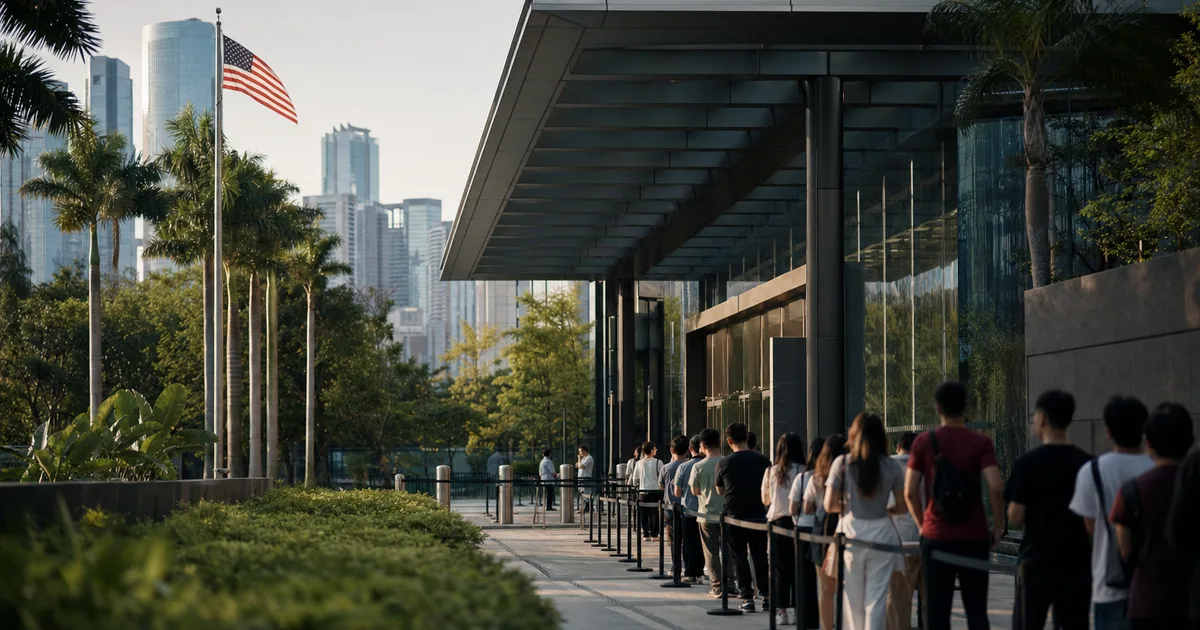
- Attend the interview. Arrive 15 minutes early. The security screening at the consulate entrance is thorough — no phones inside. Bring only what you need.
- Wait for your passport. If approved at the window, your stamped passport is returned via courier or in-person pickup, typically within 1-3 business days. If you receive a 221g notice, you enter administrative processing (see below).
Appointment wait times at the Guangzhou consulate
Wait times fluctuate based on season, staffing, and demand. The following reflects general patterns as of early 2026 — check the US Travel portal for real-time availability:
| Season | Typical Appointment Wait (Guangzhou) | Notes |
|---|---|---|
| January – March | 2–6 weeks | Post-holiday demand spike in January |
| April – June | 3–8 weeks | Pre-summer travel rush |
| July – September | 4–10 weeks | Peak summer; plan ahead |
| October – December | 2–5 weeks | Demand drops after summer; faster windows |
These are rough ranges. Some applicants have found same-week appointments after cancellations; others have waited 12+ weeks during high-demand stretches. Checking the portal daily at non-peak hours (early morning Beijing time) can surface cancellation slots.
Emergency appointments: If you have a documented urgent need (imminent job start date, medical emergency, etc.), the consulate does maintain a small number of emergency appointment slots. Contact the consulate via their official inquiry portal to request one. These are not guaranteed.
The complete document checklist for H-1B stamping in China
Bring originals and one photocopy of everything. Document deficiencies are the single largest cause of same-day 221g holds.
Identity and immigration documents
- Valid passport (must be valid at least 6 months beyond your intended entry date)
- All prior passports containing prior US visas
- DS-160 confirmation page (printed, with barcode visible)
- Appointment confirmation printout
- Prior US visa (if any)
- I-94 departure record printout from cbp.dhs.gov (if you previously entered the US)
H-1B petition documents
- Original I-797 approval notice for your current H-1B petition
- All prior I-797 approval notices (H-1B, cap-exemptions, extensions, transfers)
- Current Labor Condition Application (LCA) — Form ETA-9035E, certified by the Department of Labor
- Employer support letter on company letterhead, signed by an authorized officer, describing your position, start date, salary, and the employer's intent to continue employment
- Offer letter or employment contract
Employer supporting evidence (strongly recommended)
- Company W-2 or pay stubs from the past 3-6 months
- Company financial statements or recent annual report (shows the employer is financially healthy)
- Company federal tax returns (Form 941 or excerpts) — optional but useful
- Company website printout, org chart, recent news articles showing company is operational
Your personal qualifications
- All academic degrees and transcripts (originals preferred; certified copies acceptable)
- Foreign degree credential evaluation (if your degree is not from a US institution — evaluation from a NACES-member organization)
- Professional licenses or certifications relevant to your role
- Employment verification letters from prior employers if relevant to specialty-occupation argument
Photographs
- One recent 2x2 inch visa photograph (follow the US State Department photo requirements exactly)
MRV fee receipt
Optional but useful
- A brief personal statement or cover letter explaining your specialty occupation if your role is in a field that has faced recent H-1B RFEs (e.g., computer systems analyst, market research roles)
- Evidence of ties to China (property, family) is not required for H-1B nonimmigrant visas, but having it ready does not hurt
What happens at the interview window
The Guangzhou consulate runs visa interviews at individual windows, similar to bank tellers. You'll hand over your documents, the officer will review your DS-160 on screen, and they will ask a series of standard questions. For H-1B applicants, common questions include:
- What does your company do?
- What is your job title and primary responsibility?
- Where is the office location?
- Who is your direct supervisor?
- How long have you been with this employer?
- What was your highest degree and where did you earn it?
Keep answers short, factual, and consistent with your DS-160 and I-797. Officers are looking for consistency, not elaboration. If you don't understand a question, ask politely for it to be repeated.
Administrative processing (221g) — what it means and how to handle it
If the officer cannot approve your visa at the window, they will return your passport with a 221g notice. This is not a denial. It means the consulate needs more information or more time to process your case. The notice will be one of two types:
Checklist 221g: The officer requests specific additional documents. Submit them promptly (usually within the timeframe specified in the notice). Faster submission almost always means faster resolution.
Non-checklist 221g (security review): No documents are requested — your case enters administrative processing for security clearance or Technology Alert List (TAL) checks. This affects applicants in technology-intensive fields including semiconductor engineering, aerospace, AI research, certain biotech roles, and others. TAL review timelines are unpredictable and can range from a few weeks to several months.
For more on navigating a 221g hold, see our guide to 221g administrative processing.
What you can do during 221g
- Submit any requested documents immediately
- Monitor your case status at ceac.state.gov with your case number
- After 60 days of no movement, contact the consulate via the official inquiry portal
- Do not rebook travel until you have the stamped passport in hand
- Keep your employer's immigration attorney informed — some consulates respond faster when attorney inquiries come through official channels
Impact on your employment: A long 221g hold means you cannot re-enter the US without a new visa stamp. If your authorized period of employment continues in your I-797, your employment authorization technically remains valid inside the US — but you cannot exercise it from China. Discuss the timing of your travel with your employer before you leave. See our cap-gap travel risks guide for related timing considerations.
Third-country national stamping — applying in China as a non-Chinese national
If you are in China on a work visa or residence permit and your home country is not China, you can still apply for your H-1B stamp at a China consulate. This is known as third-country national (TCN) stamping.
The consulate officer will ask why you are not applying in your home country. Have a clear, truthful answer: you are currently working in China, your authorized stay in China is documented, and it is more practical to apply locally. Bring your China residence permit or work permit as part of your document package.
TCN applicants face slightly higher scrutiny at the window, and some consulates more commonly issue 221g holds to TCN applicants than to home-country nationals, simply because the officer cannot quickly verify domestic ties. This does not mean you should avoid TCN stamping — many applicants process successfully — but factor in extra buffer time.
If you are considering stamping in another country, read our H-1B stamping guide for India for comparison.
H-1B stamping after a job change — transferring and then going abroad
If you recently transferred your H-1B to a new employer (via I-129 petition filed under AC21 portability), your new I-797 reflects the new employer. Bring both the new I-797 and, if available, documentation showing continuity of employment — paystubs from the new employer, an updated employer letter. Officers occasionally see recently filed petitions and ask follow-up questions about the new employer's legitimacy. Having two or three months of paystubs from the new employer is the simplest way to answer those questions.
For a refresher on how H-1B transfers work, see our H-1B transfer playbook.
Common mistakes that cause delays or refusals
Bringing an incomplete document package
The single most preventable delay is showing up without key documents. Missing LCA, missing employer support letter, or bringing a photocopy of your I-797 instead of the original are all common. Use the checklist above. Double-check it the night before.
Inconsistencies between your DS-160 and your I-797
If your DS-160 lists your job title differently than your I-797, officers flag it. Copy the exact job title from your I-797 into the DS-160. The same goes for employer name, start date, and annual salary.
Traveling during a sensitive period in your case
If your H-1B extension petition is pending (not yet approved), leaving the US and applying for a stamp in China puts you in a tricky position. You cannot enter the US with a pending petition alone — you need a valid visa stamp. If you leave with a pending petition and do not yet have a visa stamp, you may be stuck waiting until that petition is approved and then you attend the consulate interview. Avoid international travel while a petition is pending unless your attorney has specifically cleared the timing.
Underestimating the 221g hold timeline
Applicants frequently plan to be in China for 1-2 weeks and find themselves stuck for 6-8 weeks due to 221g. If you cannot afford to be out of the US for an extended period, either (a) plan a longer stay buffer, or (b) consult your attorney about whether your specific role is likely to trigger TAL review before you travel.
Not informing your employer before you leave
Your employer needs to know you are traveling internationally and why. If the consulate calls to verify your employment (this does happen), your employer's HR should know to expect and confirm the call. If you leave without telling your employer and HR cannot verify your employment details, the consulate may issue a 221g. A simple email to HR and your manager before departure covers this.
Booking one-way or non-refundable return flights
Do not book a non-refundable return flight for a date close to your interview. 221g holds have no guaranteed resolution date. Book refundable tickets or plan a flexible stay.
Frequently asked questions
How long does H-1B visa stamping take at the Guangzhou consulate in 2026?
Appointment wait times at the Guangzhou US Consulate for H-1B nonimmigrant visas have ranged from a few weeks to several months depending on the time of year. Once you attend your interview, same-day or next-business-day issuance is common for straightforward cases. Administrative processing (221g) adds 4-12 weeks on average, though complex cases have taken longer. Check the US Consulate Guangzhou appointment availability page directly for current wait times, as they shift frequently.
Can I get my H-1B stamped in China if my home country is not China?
Yes. US consulates generally permit third-country national stamping, meaning you can apply at a consulate in a country other than your nationality if you are physically present there and have legal status. However, officers have discretion to return your application to your home country post. Bring documentation of your legal presence in China (work visa, residence permit) and be prepared to explain why you are applying at this post rather than in your home country.
What documents do I need for H-1B stamping at a China US consulate?
Core documents include your DS-160 confirmation, appointment confirmation, valid passport, prior US visas, I-797 approval notice (original), support letter from your employer, current LCA, offer letter or employment contract, pay stubs, and educational credentials. Supporting evidence of your employer's legitimacy — such as recent tax filings, financial statements, or website printouts — reduces the chance of a 221g administrative hold. A full checklist is in the document checklist section above.
What is administrative processing (221g) and how long does it take for China H-1B applicants?
After your consulate interview, the officer may stamp your passport with a 221g notice requiring additional review before your visa can be issued. This is not a denial — it is a hold while the consulate or the Department of State conducts further checks. For H-1B applicants processed in China, 221g holds commonly add 4 to 12 weeks. Technology and research roles may trigger longer security clearance checks (sometimes called Technology Alert List reviews) that can last several months. Responding quickly to any supplemental document requests reduces delays.
Is it safe to travel to China for H-1B stamping given the risk of getting stuck?
The main risk is an extended administrative processing hold that delays your return to the US, which can disrupt your employment. Before you travel, confirm with your employer and immigration attorney that your trip timing does not create a gap-in-employment issue and that your employer is prepared to verify your position if the consulate reaches out. Avoid traveling during critical project deadlines. Keep copies of all documents digitally so you can respond quickly to any 221g supplemental requests from abroad.
Getting your H-1B stamped in China is manageable with the right preparation. The consulate process itself is quick — most of the calendar time is waiting for an appointment and, if it happens, waiting out administrative processing. The applicants who get stuck are almost always the ones who traveled with an incomplete document package, booked non-refundable return tickets two weeks out, or chose a travel window during a pending petition.
If you want a second set of eyes on your stamping timeline or employer evidence package before you book flights, F1Jobs works with H-1B holders through exactly this kind of pre-travel planning.
Frequently asked questions
How long does H-1B visa stamping take at the Guangzhou consulate in 2026?
Appointment wait times at the Guangzhou US Consulate for H-1B nonimmigrant visas have ranged from a few weeks to several months depending on the time of year. Once you attend your interview, same-day or next-business-day issuance is common for straightforward cases. Administrative processing (221g) adds 4-12 weeks on average, though complex cases have taken longer. Check the US Consulate Guangzhou appointment availability page directly for current wait times, as they shift frequently.
Can I get my H-1B stamped in China if my home country is not China?
Yes. US consulates generally permit "third-country national" stamping, meaning you can apply at a consulate in a country other than your nationality if you are physically present there and have legal status. However, officers have discretion to return your application to your home country post. Bring documentation of your legal presence in China (work visa, residence permit) and be prepared to explain why you are applying at this post rather than in your home country.
What documents do I need for H-1B stamping at a China US consulate?
Core documents include your DS-160 confirmation, appointment confirmation, valid passport, prior US visas, I-797 approval notice (original), support letter from your employer, current LCA, offer letter or employment contract, pay stubs, and educational credentials. Supporting evidence of your employer's legitimacy — such as recent tax filings, financial statements, or website printouts — reduces the chance of a 221g administrative hold. A full checklist is in the body of this article.
What is administrative processing (221g) and how long does it take for China H-1B applicants?
After your consulate interview, the officer may stamp your passport with a 221g notice requiring additional review before your visa can be issued. This is not a denial — it is a hold while the consulate or the Department of State conducts further checks. For H-1B applicants processed in China, 221g holds commonly add 4 to 12 weeks. Technology and research roles may trigger longer security clearance checks (sometimes called Technology Alert List reviews) that can last several months. Responding quickly to any supplemental document requests reduces delays.
Is it safe to travel to China for H-1B stamping given the risk of getting stuck?
The main risk is an extended administrative processing hold that delays your return to the US, which can disrupt your employment. Before you travel, confirm with your employer and immigration attorney that your trip timing does not create a gap-in-employment issue and that your employer is prepared to verify your position if the consulate reaches out. Avoid traveling during critical project deadlines. Keep copies of all documents digitally so you can respond quickly to any 221g supplemental requests from abroad.