H-1B Visa Stamping in Pakistan 2026: Islamabad Embassy, Karachi Consulate, and Administrative Processing Risk
Pakistan-based H-1B stamping in 2026 carries real administrative processing risk — here is what to expect at Islamabad and Karachi and how to protect yourself.
Part of our guide to H-1B visa stamping.
Updated for 2026 — check this before you book anything. The State Department now directs nonimmigrant visa applicants to apply in their country of nationality or legal residence, so third-country stamping is no longer generally available as a way around a backlog. H-1B applicants are also reported to no longer qualify for the dropbox interview waiver, meaning an in-person interview is required including for renewals. Appointment availability has tightened sharply in several countries. Parts of this article were written before those changes. Confirm the current rules on the official booking portal and with an immigration attorney before making travel plans — see why third-country H-1B stamping is no longer an option.
You have an H-1B approval in hand. Your employer filed on time, USCIS issued the I-797, and you are ready to start or return to work in the US. There is one step left: a consular interview at the US Embassy in Islamabad or the US Consulate General in Karachi, a new visa stamp in your passport, and a flight back.
For many applicants this goes smoothly. For a meaningful share — particularly those in technical fields — it does not. Administrative processing delays, which can run from a few weeks to many months, have disrupted job start dates, violated H-1B cap-gap windows, and in some cases led to candidates losing offers they had already accepted. Pakistan is not the only country where this pattern appears, but the combination of demand, security-clearance procedures, and field-of-work screening makes it a more common outcome here than in most other locations.
This guide explains the process at both posts, the appointment and wait-time reality as of 2026, what administrative processing actually means and how to respond to it, and the strategic decisions you face before you book your trip home.
The two posts and how to choose between them
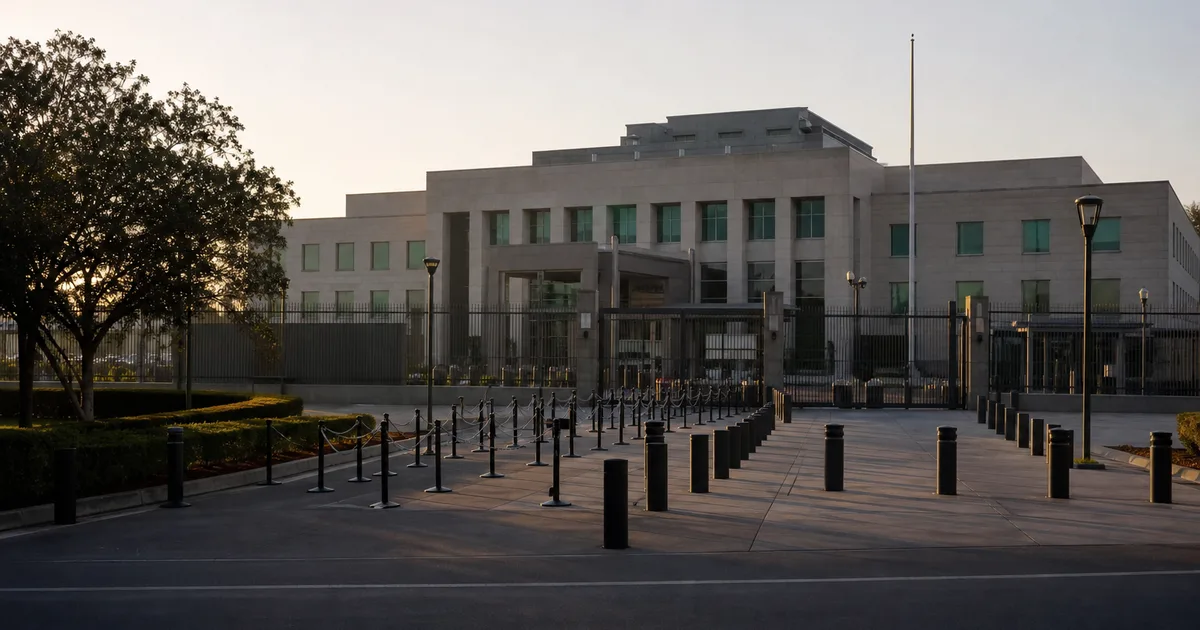
US Embassy Islamabad
The main US Embassy in Islamabad is the primary post handling nonimmigrant visas for Pakistani nationals. It processes all visa categories including H-1B, and it is the default choice for most applicants in Punjab, Khyber Pakhtunkhwa, and northern Pakistan.
Appointment scheduling goes through ustraveldocs.com. You will need to pay the MRV (Machine Readable Visa) fee — currently $205 for H-1B — before you can book. The fee receipt is valid for one year from payment.
US Consulate General Karachi
The Consulate General in Karachi handles nonimmigrant visas for applicants in Sindh and Balochistan, though there is no strict geographic restriction. If you are traveling to Karachi anyway, or if Karachi has earlier appointments available, you can legitimately choose that post. Appointment availability fluctuates independently from Islamabad.
How to compare availability
Check both posts simultaneously on ustraveldocs.com before committing. The system shows available dates for both locations after you log in. Slot availability can shift quickly — cancellations open slots at unpredictable times, so it pays to check multiple days in a row if you are trying to land the earliest possible date.
Appointment wait times in 2026
| Post | Typical appointment wait (routine periods) | Peak demand periods |
|---|---|---|
| Islamabad Embassy | 4 to 12 weeks | Up to 20+ weeks |
| Karachi Consulate | 3 to 10 weeks | Up to 16+ weeks |
These ranges are approximate and based on reported patterns through early 2026. Wait times fluctuate based on staffing, demand, and consular operations. The State Department's travel.state.gov appointment-wait-time tool publishes official estimates by post and visa category — check it directly for current figures.
Two practical notes on wait times:
-
H-1B renewal vs. first-time stamp. Both are treated as immigrant/nonimmigrant visa interview appointments at the post level — there is no "expedited lane" for H-1B renewals at Pakistani posts unless you qualify for the interview-waiver (Dropbox) program. As of 2026 the Dropbox interview-waiver program has resumed at select posts, including Pakistan under certain conditions. Check eligibility carefully: generally requires a prior visa in the same category, no refusals, fingerprints already on file, and renewal within 48 months of expiry.
-
Emergency appointments. Emergency appointments exist for genuine medical, death-in-family, or urgent travel situations. They are not a workaround for a delayed job start date. Misrepresenting urgency is grounds for visa refusal.
The interview itself
H-1B consular interviews in Pakistan follow the same structure as at other posts worldwide. The officer reviews your petition documents, asks about your employer and your role, and determines whether you meet the nonimmigrant intent standard and the H-1B specialty-occupation requirement.
Documents to bring
- Original approved I-797 (and any prior I-797s for extensions or amendments)
- DS-160 confirmation barcode page
- Valid passport (plus any expired passports containing prior US visas)
- Appointment confirmation printout
- One recent photograph meeting US visa photo specifications
- Copy of the LCA and the LCA case number
- Offer letter from your US employer
- Recent paystubs (if renewing)
- Educational credentials — original or notarized copies of degree, transcripts, and any professional certifications relevant to your specialty occupation
- For STEM or technical research roles — a brief description of your work in plain, accessible language
Your attorney does not appear with you at the consular interview. The consular officer is not bound by the USCIS specialty-occupation determination from your approved I-797. This matters: even a clean USCIS approval does not prevent an officer from placing your case in administrative processing if your field or background triggers a clearance referral.
Administrative processing — what it is and what to expect
What section 221g actually means
When a consular officer is not ready to issue your visa at the conclusion of the interview, they issue a 221g notice — a yellow, white, or blue slip depending on what additional action is needed. Yellow typically indicates a document request. White or blue typically indicates that your case is being held for administrative processing, meaning a background or security-clearance review is required before the visa can be approved or denied.
Administrative processing is not a denial. You are still eligible for the visa in theory. But there is no timeline guarantee, no appeal mechanism, and CEAC (the State Department's online visa-status tracker at ceac.state.gov) will simply show "Administrative Processing" until the review is complete.
Why Pakistan applicants see elevated administrative processing rates
Security-clearance procedures — sometimes referred to by applicants as Visas Mantis, Technology Alert List screening, or similar names — apply based on a combination of applicant nationality and the technical nature of the work. The State Department does not publish exact criteria, but fields that consistently appear in reported cases include:
- Software engineering and computer science, particularly roles touching cryptography, network security, or AI/ML
- Electrical and electronic engineering
- Chemical engineering and chemistry
- Nuclear, aerospace, and materials science
- Biomedical research and certain life-science roles
- Any role where the employer's work could plausibly touch dual-use technology
Pakistani nationals in these fields face a statistically higher likelihood of administrative processing than applicants in the same roles from many other countries. This is a consular reality you need to plan around — not a personal failing and not necessarily a signal about your case outcome.
How long administrative processing takes
Reported timelines vary enormously. Some cases clear in 2 to 4 weeks. Others run 3 to 6 months. A smaller share exceeds 6 months, particularly in years with heightened security-clearance backlogs. There is no public data on median clearance times for Pakistani applicants specifically.
The CEAC status tool is the only official tracking mechanism. If your case shows administrative processing for more than 60 days, you can submit a status inquiry through the embassy's designated inquiry form or email address, but responses are typically limited to confirming that the case is still pending.
Step-by-step response if you are placed in administrative processing
- Collect and retain your 221g notice. The slip specifies whether additional documents are needed. If documents are requested, submit them promptly and keep copies of everything you send.
- Notify your employer and immigration attorney immediately. Your H-1B start date or return date will likely need to be pushed. Your employer's HR and legal team need lead time.
- Check CEAC status regularly — not obsessively, but every week or two.
- Do not make irrevocable travel or financial commitments based on an assumed clearance date.
- If you are in the US on OPT or an expiring status, understand that traveling abroad while waiting for H-1B stamping may leave you unable to return on time. See the relevant section below.
For a deeper treatment of 221g responses and escalation options, see our guide on consular 221g administrative processing.
Status implications: timing your trip carefully
This section matters most if you are currently inside the US and planning to travel to Pakistan for stamping.
If you are on STEM OPT
STEM OPT has a 90-day unemployment limit and a 24-month maximum extension from the initial 12-month OPT period. If you travel abroad while on STEM OPT for stamping and your case enters administrative processing, you could exhaust your STEM OPT validity before returning — putting you out of status. Before traveling, confirm:
- How much STEM OPT time remains
- Whether your employer has filed an H-1B petition that is pending or approved
- Whether you have a cap-gap situation (see below)
Cap-gap window
If you are on OPT or STEM OPT bridging into H-1B via the cap-gap provision (status and work authorization extended through September 30 or beyond, pending H-1B), traveling outside the US during cap-gap can be risky. The cap-gap status does not protect you while you are abroad — it applies to maintain status inside the US. Returning from Pakistan requires a valid visa stamp. If your stamping is delayed by administrative processing, you may be unable to re-enter before your cap-gap authorization runs out. Read our cap-gap travel risks guide before booking any international travel during this window.
Already outside the US with a pending H-1B
If you are in Pakistan and waiting for your H-1B to be stamped for the first time, rather than as a renewal, you are in a separate situation — consular processing vs. change of status involves different risk profiles. The core issue is the same: you cannot enter the US in H-1B status until you hold a valid H-1B visa stamp.
Third-country stamping — is it worth it?
Some Pakistan-based applicants attempt to schedule their H-1B interview at a US post in a third country — most commonly the UAE (Dubai or Abu Dhabi), Saudi Arabia (Riyadh), or the UK (London) — to avoid longer Pakistan-specific waits or elevated administrative processing patterns.
This strategy has real limitations in 2026:
- Most posts outside your home country schedule nonimmigrant visa appointments only for legal residents of that country, not for short-term visitors seeking to stamp there
- Getting an exception requires directly contacting the post and demonstrating a legitimate connection to that country
- Even if you succeed in getting an interview abroad, you are not guaranteed a lower administrative processing rate — the clearance is field- and nationality-based, not post-specific
Third-country stamping is worth exploring if you have a legitimate residence connection to another country, but it is not a reliable shortcut for most applicants. Our guide on H-1B stamping in India covers the India-specific version of this question if India is a realistic option for you.
H-1B administrative processing and the $100K fee question
A note on a common confusion: the White House proclamation that imposed a $100,000 fee on certain new H-1B petitions for workers outside the US (effective September 2025, upheld in federal court December 2025) does not affect your stamping appointment or the consular officer's review. The fee applies at the USCIS petition level, not the consular level. If your employer already paid it as part of your new or renewed petition, that is settled. If you are renewing an existing H-1B and were already in the US, the fee likely did not apply to your case at all.
For clarity on H-1B fee and petition costs in 2026, see the USCIS fee schedule guide.
If your backup plan matters — and it should
For Pakistan-based applicants in technical fields, building a backup plan before you travel for stamping is not pessimistic — it is practical. Options to understand in advance:
- Stay on STEM OPT if possible until you have successfully stamped and returned, rather than timing a trip to Pakistan during the cap-gap window
- Know your employer's policy on delayed start dates before the trip so there is no surprise conversation after the fact
- Understand the O-1 path if your credentials are strong and H-1B stamping continues to be problematic — O-1 visa guide
- Know your H-1B backup options more broadly: H-1B backup plans after the lottery covers the landscape for situations where H-1B status is disrupted
Common mistakes
Booking non-refundable flights and hotel before having a visa in hand. Administrative processing can delay your return by weeks or months. Book refundable or changeable travel until your passport is physically returned with the visa.
Not telling your employer the real timeline risk. Many applicants downplay the administrative processing possibility to avoid looking like a problem hire. The conversation is uncomfortable once and catastrophic if it comes as a surprise three months in. Have it upfront.
Traveling during STEM OPT or cap-gap without understanding the re-entry requirement. The most common source of status problems in this scenario. Your ability to re-enter the US depends on holding a valid visa stamp — cap-gap status protects you inside the US only.
Waiting until your current visa stamp has expired to schedule an appointment. You can generally work on a valid I-797 approval notice with an expired stamp (for H-1B specifically, the stamp is only needed to enter the US, not to maintain status inside it), but scheduling early gives you a buffer if administrative processing delays things.
Ignoring the DS-160 accuracy requirement. Every answer on the DS-160 must be truthful and consistent with your I-797 and supporting documents. Inconsistencies — even innocent ones — can prompt additional questioning or hold a case.
Assuming a previously issued US visa means easy renewal. A prior visa in the same category is a positive data point for the officer, but it does not prevent administrative processing or a new interview. Prior issuance does not bind the consular officer.
Frequently asked questions
How long does H-1B visa stamping take at the Islamabad US embassy in 2026?
Appointment wait times at the US Embassy in Islamabad have ranged from several weeks to several months depending on visa class and demand. After your interview, routine approvals are typically processed within a few business days, but cases sent to administrative processing (section 221g) can take weeks to many months with no guaranteed timeline. Plan conservatively and do not book non-refundable travel until your passport is physically returned.
What is administrative processing and why does it affect Pakistan applicants more?
Administrative processing under section 221g means the consular officer needs additional review before issuing the visa — it is not a denial. Pakistan applicants face elevated rates of administrative processing due to security-clearance checks that apply based on applicant nationality and field of work. Tech, engineering, science, and certain dual-use research fields are more commonly flagged. There is no appeal process and no guaranteed completion date.
Can I use the Karachi consulate instead of Islamabad for H-1B stamping?
Yes. The US Consulate General in Karachi handles nonimmigrant visa stamping including H-1B. Appointment availability and wait times differ from Islamabad and can sometimes be shorter or longer depending on the time of year. Both posts use the same DS-160 application and ustraveldocs.com scheduling system, so you can check both locations when booking and choose whichever has the earlier slot.
Should I apply for a visa at a third country instead of stamping in Pakistan?
Third-country stamping at posts in the UAE, Saudi Arabia, or the UK is an option some Pakistan-based applicants explore to avoid longer wait times or administrative processing patterns. However, most posts outside your home country will only schedule appointments for residents of that country. Confirm eligibility directly with the target post before purchasing tickets or making plans around that option.
What documents should I bring to my H-1B visa interview in Pakistan?
Bring your original approved I-797 approval notice, the DS-160 confirmation page, a valid passport, the appointment confirmation, one recent photograph meeting US visa photo specs, evidence of your employer-employee relationship, the LCA number and a copy, your most recent educational credentials, and any prior US visa stamps. If your role involves STEM or technical research, having a brief plain-language description of your work ready can help the officer understand why your position qualifies and is not dual-use sensitive.
Heading to Pakistan for stamping, or already stuck in administrative processing? F1Jobs works with international professionals on exactly these situations — reach out and we can help you think through timing, employer communication, and fallback options.
Frequently asked questions
How long does H-1B visa stamping take at the Islamabad US embassy in 2026?
Appointment wait times at the US Embassy in Islamabad have ranged from several weeks to several months depending on visa class and demand. After your interview, routine approvals are typically processed within a few business days, but cases sent to administrative processing (section 221g) can take weeks to many months with no guaranteed timeline. Plan conservatively and do not book non-refundable travel until your passport is physically returned.
What is administrative processing and why does it affect Pakistan applicants more?
Administrative processing under section 221g means the consular officer needs additional review before issuing the visa — it is not a denial. Pakistan applicants face elevated rates of administrative processing due to security-clearance checks (sometimes called Visas Mantis or similar clearance procedures) that apply based on applicant nationality and field of work. Tech, engineering, science, and certain dual-use research fields are more commonly flagged. There is no appeal process and no guaranteed completion date.
Can I use the Karachi consulate instead of Islamabad for H-1B stamping?
Yes. The US Consulate General in Karachi handles nonimmigrant visa stamping including H-1B. Appointment availability and wait times differ from Islamabad and can sometimes be shorter or longer depending on the time of year. Both posts use the same DS-160 application and ustraveldocs.com scheduling system, so you can check both locations when booking and choose whichever has the earlier slot.
Should I apply for a visa at a third country instead of stamping in Pakistan?
Third-country stamping (for example at the US Embassy in Riyadh, Dubai, or Abu Dhabi) is an option some Pakistan-based applicants explore to avoid longer Pakistan-specific wait times or administrative processing patterns. However, most posts outside your home country will only schedule appointments for residents of that country, and exceptions are narrower than they used to be. Confirm eligibility directly with the target post before purchasing tickets or making plans around that option.
What documents should I bring to my H-1B visa interview in Pakistan?
Bring your original approved I-797 approval notice, the DS-160 confirmation page, a valid passport, the appointment confirmation, one recent photograph meeting US visa photo specs, evidence of your employer-employee relationship (offer letter, paystubs if renewing), the Labor Condition Application (LCA) number and a copy, your most recent educational credentials, and any prior US visa stamps. If your role involves STEM or technical research, having a brief plain-language description of your work ready can help the officer understand why your position qualifies and is not dual-use sensitive.