H-1B Visa Stamping in the Philippines 2026: Manila Embassy, Wait Times, and the 221(g) Trap
Your H-1B was approved but now you need the visa stamp in Manila — here is what to expect from appointment wait times to the 221(g) trap in 2026.
Part of our guide to H-1B visa stamping.
Updated for 2026 — check this before you book anything. The State Department now directs nonimmigrant visa applicants to apply in their country of nationality or legal residence, so third-country stamping is no longer generally available as a way around a backlog. H-1B applicants are also reported to no longer qualify for the dropbox interview waiver, meaning an in-person interview is required including for renewals. Appointment availability has tightened sharply in several countries. Parts of this article were written before those changes. Confirm the current rules on the official booking portal and with an immigration attorney before making travel plans — see why third-country H-1B stamping is no longer an option.
You have an approved H-1B petition — the I-797 approval notice is in your inbox, your employer's immigration attorney gave you the green light, and your flight to the Philippines is booked. Now comes the part that sends anxiety through every H-1B holder: walking into the US Embassy in Manila, sitting across from a consular officer, and walking back out with a visa stamp instead of a slip of paper that starts with "221(g)."
Most Manila H-1B interviews end without drama. The officer verifies your documents, confirms the basics of your role, and your passport comes back a few days later with a new visa. But the consular stage has produced some of the worst surprises in the H-1B journey — months-long administrative processing holds, visa denials that USCIS had nothing to do with, and people stranded abroad while their US employer's patience runs thin. This guide covers what actually happens at the Manila US Embassy for H-1B applicants in 2026, how to prepare, what the wait times look like, and specifically how to avoid and survive the 221(g) administrative processing hold.
Who needs to go through Manila for H-1B stamping
If you are a Filipino citizen who received H-1B approval via Change of Status inside the US, you do not need a visa stamp to work — your change of status I-94 is your authorization. The visa stamp only becomes necessary when you travel outside the US and need to re-enter.
The Manila US Embassy applies to you if any of these is true:
- You are in the Philippines and need to enter the US for the first time on H-1B (consular processing)
- You are a Filipino national living in the Philippines or abroad (including as an OFW) applying for H-1B for the first time
- You traveled outside the US while on H-1B and your prior visa stamp expired — you need a new stamp before re-entering
- You are renewing your H-1B and opted to do the stamp renewal during a trip home rather than dealing with a US embassy elsewhere
Notably, you can apply for a US visa at an embassy or consulate other than your home country's — a practice called third-country stamping — but Manila tends to be faster and more familiar territory for Filipino nationals than, say, doing it in Canada. For comparison on how the process differs regionally, see our H-1B stamping India 2026 guide for a parallel country example.
The Manila US Embassy: logistics and appointment booking
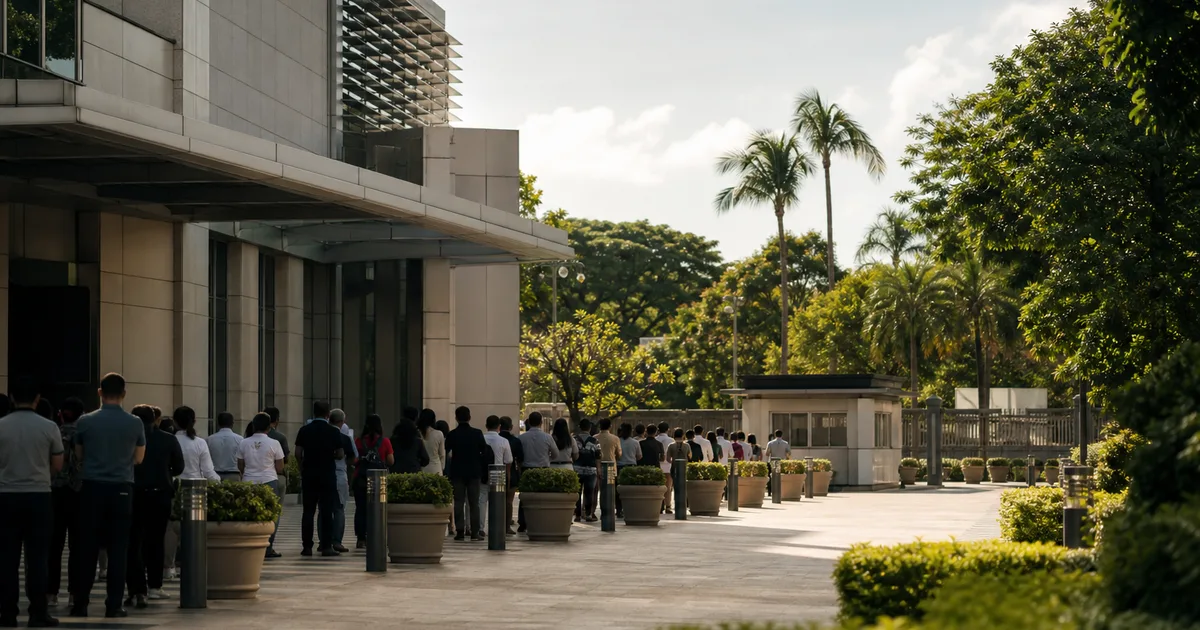
The US Embassy in Manila is located in the Seafront Complex on Roxas Boulevard in Pasay City. For nonimmigrant visa applicants including H-1B, the intake process runs through the official US Travel Docs portal (ustraveldocs.com/ph), which is the only sanctioned booking platform.
Steps to schedule your Manila H-1B interview
- Complete your DS-160 nonimmigrant visa application at ceac.state.gov. Save the barcode number — you cannot book an appointment without it.
- Pay the MRV (Machine Readable Visa) fee. As of 2026, the NIV fee for H-1B is $190. Payment options in the Philippines include BancNet online payment or over-the-counter at specific banks. The fee is non-refundable.
- Create a profile on the US Travel Docs portal and link your DS-160 and payment receipt.
- Schedule your interview appointment.
Current wait times for H-1B interview appointments in Manila
Appointment availability at Manila fluctuates based on staffing, season, and demand surges. As of early-to-mid 2026, the nonimmigrant visa appointment wait at Manila has generally run between 2 and 8 weeks for initial scheduling, though this can compress or extend depending on the time of year.
| Period | Typical Appointment Wait | Notes |
|---|---|---|
| January to March | 2 to 5 weeks | Quieter period post-holiday surge |
| April to June | 3 to 8 weeks | Pre-summer travel demand rises |
| July to September | 4 to 10 weeks | Peak summer/OFW season |
| October to December | 3 to 7 weeks | Holiday surge, some availability opens in November |
These are general patterns — not guarantees. Check the live calendar when you book; cancellation slots appear daily. If your employer needs you back in the US by a specific date, book as soon as your I-797 is in hand and build in at least 3 weeks of buffer beyond the interview date to account for processing and potential 221(g).
Dropbox (interview waiver) appointments, if you qualify, tend to have shorter waits than full interview appointments. If you held a prior H-1B, H-4, or other nonimmigrant visa that was previously issued at interview, and it expired within 48 months, you may qualify. Use the embassy's eligibility screening tool before assuming you qualify — the criteria are more specific than they appear.
The day of your interview: what to expect
The Manila Embassy operates a staged security and intake process. Arrive 15-20 minutes before your scheduled slot. No phones or electronics are allowed inside the consular section — the embassy operates a storage area for these items outside.
Required documents for your H-1B interview
Bring originals and photocopies of each:
- Valid passport (must be valid at least 6 months beyond your intended US stay)
- All prior passports containing any US visa history
- DS-160 confirmation page (with barcode)
- Interview appointment confirmation printout
- One passport-style photo per US specifications (though biometrics are collected on-site)
- Original or attorney-provided copy of your I-797 Notice of Action (H-1B approval)
- Support letter from your US employer on company letterhead, signed by HR or an officer
- Offer letter or recent pay stubs showing your H-1B wage
- Your educational transcripts and degree certificate (originals if possible)
- Any prior US visa approvals or I-797s from previous H-1B periods
- LCA (Labor Condition Application) summary if provided by your attorney
The single most common document error at Manila H-1B interviews is arriving without the I-797. Some applicants assume the consular officer can look it up — they generally cannot rely solely on internal records. Bring it physically.
What the consular officer asks
For a standard H-1B interview in Manila, the interview itself is typically brief — often under 10 minutes. Common questions:
- What is your job title and what do you actually do day to day?
- Who is your employer and where is the worksite?
- How long have you held this role?
- What is your educational background?
- Have you previously been to the United States?
- Do you intend to return to the Philippines after your authorized stay?
Answer directly and consistently with your DS-160. Inconsistencies between your DS-160 answers and what you say verbally are a leading cause of same-day referral to administrative processing. If you stated your employer's headquarters address on the DS-160 but your actual worksite is different (a common situation in H-1B given LCA worksite amendments), be prepared to explain that clearly.
Understanding the 221(g) trap
Section 221(g) of the Immigration and Nationality Act allows a consular officer to refuse issuance of a visa when additional information is needed or when the case requires administrative review. It is not a denial — it is a hold. But for H-1B applicants traveling home between jobs or on a schedule, it can cause serious disruption.
What the 221(g) slip means
You will receive either a white or pink/colored 221(g) form at the interview or shortly after. The form states whether additional documents are required or whether the hold is pending administrative processing (no documents needed from you — the consulate needs to complete internal review).
Two types:
- Document request 221(g): You must provide additional paperwork. Respond quickly and completely. The faster you submit, the faster the clock restarts.
- Administrative processing 221(g): No action required from you immediately. Your case is under additional security or background review. The wait can range from a few weeks to several months. There is no mechanism to force a timeline.
For the administrative processing variety, the State Department's CEAC portal will show "Administrative Processing" as the status. Most applicants see this resolve — either to approval or to a request for additional documents — within 60 to 90 days. Some technology-adjacent roles, particularly in semiconductors, AI research, defense systems, or biotechnology, have seen delays of 6 months or more. See our detailed guide on consular 221(g) administrative processing for a full breakdown of the review types.
Common triggers for 221(g) in Manila for H-1B applicants
- Technology Alert List (TAL) hits: Roles involving controlled technologies, dual-use research, or work with certain foreign-government-affiliated institutions can trigger State Department security review under the Visas Mantis or related programs
- Prior 221(g) history: If you received administrative processing in a prior visa application anywhere in the world, it increases the likelihood of another hold
- Employment gaps or inconsistencies: Periods without employment not explained in the DS-160, or role changes mid-petition period
- Third-party placement / consulting patterns: H-1B holders placed at client worksites through staffing or consulting firms have historically drawn more scrutiny
- DS-160 vs. I-129 discrepancies: Job title, employer, or worksite listed differently across documents
- Name matches in security databases: Common Filipino names can generate false positives in automated matching
How to reduce your 221(g) risk before the interview
- Have your attorney review your DS-160 against your approved I-129 and LCA for consistency before you file
- Bring a clean, organized packet that maps your role directly to the H-1B petition — the consular officer should not have to guess what you do
- If your role involves any technology that could plausibly be dual-use, be ready to explain it in plain non-technical language
- Disclose prior US visa history accurately — concealment is worse than a prior refusal
- If you have a prior 221(g) on your record, brief your attorney so they can help you prepare an explanatory cover letter in advance
What to do if you receive a 221(g)
- Read the form carefully — identify whether it is a document request or administrative processing hold
- If documents are requested, compile and submit them through the embassy's specified channel (often via a drop-off or courier service to the consulate rather than re-scheduling an interview)
- Monitor your CEAC status daily at ceac.state.gov
- Notify your US employer immediately — they may need to file an extension if your current authorized stay expires while you are waiting
- Do not rebook a flight to the US until the CEAC portal shows "Issued" — attempting to re-enter without the visa stamp (if your prior stamp expired) will result in a refusal at the port of entry
For deeper guidance on navigating an open 221(g) hold, our consular 221(g) administrative processing guide covers the response process in detail.
OFW returning professionals: specific considerations
A meaningful portion of Filipinos who apply for H-1B stamping in Manila are returning OFWs — professionals who worked in the Middle East, Southeast Asia, or elsewhere, then landed a US employer willing to sponsor H-1B. The consular interview for this profile is generally straightforward, but a few things come up disproportionately:
- Employment chronology: OFW stints often produce work history in countries or roles that are harder for a consular officer to quickly verify. Bring employment contracts, payslips, or tax records from your OFW period to establish continuity
- Ties to home country: US visa law requires the officer to assess whether you have a residence abroad you do not intend to abandon. As an H-1B applicant you are asserting non-immigrant intent for the duration of the visa, even though you can pursue a green card in parallel. The consular officer is aware of this dual-intent doctrine for H-1B holders — you do not need to pretend you have no US immigration aspirations, but be clear that your current purpose is employment on H-1B
- OFW remittance accounts: Some OFWs have substantial foreign bank accounts that get flagged in public charge reviews — but the public charge rule under INA 212(a)(4) is far less relevant for H-1B employment-based applicants than for family-based ones. It should not be a material issue for you
- Health requirements: Bring vaccination records. While the standard nonimmigrant interview does not require medical examination for H-1B (unlike immigrant visas), having your records handy avoids any confusion if the officer asks
After the interview: passport pickup and re-entry
If approved, the embassy will retain your passport and return it with the visa stamp affixed. In Manila, passport return is generally by courier to an address you designate (via the LBC or similar partner), or you can arrange to pick it up at an authorized location. Processing time after a clean approval is typically 2 to 5 business days.
Once your stamped passport is back in hand, confirm the following before traveling:
- Visa validity dates and authorized period
- Number of entries (H-1B visas are typically issued for multiple entries for the full validity period)
- That the employer name matches your I-797
At the US port of entry, present your stamped passport, I-797 approval notice, and the address where you will be staying. CBP will issue you a new I-94 record. After entry, verify your I-94 at cbp.dhs.gov/i94 within a few days — the I-94 date, not your visa stamp expiration, is what determines how long you can stay.
Timeline: H-1B stamping in Manila from start to finish
Here is a realistic step-by-step sequence assuming a clean case with no 221(g):
- Week 0: Receive I-797 approval notice from USCIS. Book travel to Philippines.
- Week 1: Complete DS-160. Pay MRV fee.
- Week 1-2: Book interview appointment on US Travel Docs portal.
- Week 3-9: Interview date (depending on availability).
- Interview day: Attend interview with complete document packet. Receive blue slip (approved, pending stamping) or 221(g) slip.
- 2-5 business days after interview: Passport returned with visa stamp via courier or pickup.
- Within days of receiving passport: Book flights. Travel to US.
- At US port of entry: Present stamped passport and I-797. CBP issues I-94.
- Within 3 days of arrival: Verify I-94 at cbp.dhs.gov/i94. Confirm it matches your intended authorized stay.
If your case goes to 221(g) administrative processing, insert an open-ended hold between steps 5 and 6. Communicate with your employer and attorney immediately so your US-side status doesn't lapse while waiting. If your current H-1B status is expiring, your attorney may need to file an extension petition — see the H-1B transfer playbook for related guidance on maintaining status continuity.
Common mistakes
Filing the DS-160 without cross-checking the I-129 and LCA. The three documents need to be consistent on employer name, job title, and worksite. Discrepancies are the leading preventable cause of 221(g).
Traveling without a buffer before your return-to-work date. Even a clean Manila interview takes 2-5 business days for passport return. Build in at least 2-3 weeks of margin from interview date to your planned first day back in the US.
Assuming Dropbox eligibility without checking. Many applicants expect to use the interview waiver program and discover at scheduling that they do not qualify — because their prior visa expired more than 48 months ago, or they have a prior refusal. Check the eligibility tool first.
Booking the return flight before the passport is in hand. Flight change fees are far cheaper than arriving at the airport with an unstamped passport because you assumed the courier would deliver on time.
Not telling your employer about a 221(g) immediately. Your employer needs lead time to potentially file an extension, manage your project assignment, or assess alternatives. Silence while waiting for administrative processing to resolve creates avoidable surprises on both sides.
Visiting the Philippines on a short trip while H-1B is pending at USCIS. If your Change of Status application is pending at USCIS and you leave the US, USCIS abandons the Change of Status request. You would then need to complete consular processing in Manila instead. This is not always a problem but it is a consequential, irreversible choice. Confirm with your attorney before booking any international travel while I-129 is pending.
Frequently asked questions
How long does the Manila US Embassy take to process an H-1B visa stamp in 2026?
Most straightforward H-1B approvals at the Manila US Embassy receive the visa stamp within 2 to 5 business days after the interview. However, if your case is placed in 221(g) administrative processing, the additional wait can range from a few weeks to several months depending on the nature of the hold. Science, technology, and engineering roles that trigger a technology alert have historically seen longer delays.
Can I do dropbox (interview waiver) for my H-1B renewal stamping in Manila?
The Dropbox interview-waiver program is available in Manila for eligible renewal applicants who were previously interviewed for the same visa class and whose most recent visa expired within the past 48 months. Eligibility also requires no refused visas and no criminal or immigration violations. Check the current US Embassy Manila Dropbox eligibility tool at the time of your application since criteria can shift without much notice.
What triggers a 221(g) administrative processing hold for H-1B applicants in Manila?
A 221(g) hold means the consular officer needs more information or must refer your case for additional review before issuing the visa. Common triggers include roles in semiconductors, AI, defense technology, or biotechnology that fall under technology alert categories; gaps in employment history; prior visa refusals; prior administrative processing; discrepancies between the I-129 petition and your DS-160; or a name match in security databases. It does not automatically mean your visa will be denied.
Is it safe for an OFW returning from the Middle East or abroad to apply for H-1B stamping in Manila?
Yes. Filipino nationals who hold an approved H-1B petition and need a visa stamp can apply at the Manila US Embassy regardless of where they have been living or working. Being an OFW does not disqualify you. Bring documentation of your current employment situation, your approved I-797 approval notice, and any prior US visa history. Be straightforward about your OFW background at the interview.
What documents do I need for an H-1B visa interview at the Manila US Embassy?
Bring your valid passport, prior passports with any US visa history, DS-160 confirmation page, interview appointment confirmation, one recent passport photo meeting US specifications, the original or copy of your I-797 approval notice, a current employer support letter, your most recent pay stubs or offer letter, educational credentials, and any LCA documentation your attorney provides. Carry originals and copies. Missing the I-797 is the single most common document error at Manila.
Going through H-1B stamping for the first time or working through a 221(g) hold? F1Jobs — our team works with international candidates navigating every stage of the consular process.
Frequently asked questions
How long does the Manila US Embassy take to process an H-1B visa stamp in 2026?
Most straightforward H-1B approvals at the Manila US Embassy receive the visa stamp within 2 to 5 business days after the interview. However, if your case is placed in 221(g) administrative processing, the additional wait can range from a few weeks to several months depending on the nature of the hold. Science, technology, and engineering roles that trigger a technology alert have historically seen longer delays.
Can I do dropbox (interview waiver) for my H-1B renewal stamping in Manila?
The Dropbox interview-waiver program is available in Manila for eligible renewal applicants who were previously interviewed for the same visa class and whose most recent visa expired within the past 48 months. Eligibility also requires no refused visas and no criminal or immigration violations. Check the current US Embassy Manila Dropbox eligibility tool at the time of your application since criteria can shift without much notice.
What triggers a 221(g) administrative processing hold for H-1B applicants in Manila?
A 221(g) hold means the consular officer needs more information or must refer your case for additional review before issuing the visa. Common triggers include roles in semiconductors, AI, defense technology, or biotechnology that fall under technology alert categories; gaps in employment history; prior visa refusals; prior administrative processing; discrepancies between the I-129 petition and your DS-160; or a name match in security databases. It does not automatically mean your visa will be denied.
Is it safe for an OFW returning from the Middle East or abroad to apply for H-1B stamping in Manila?
Yes. Filipino nationals who hold an approved H-1B petition and need a visa stamp can apply at the Manila US Embassy regardless of where they have been living or working. Being an OFW does not disqualify you. Bring documentation of your current employment situation, your approved I-797 approval notice, and any prior US visa history. Be straightforward about your OFW background at the interview.
What documents do I need for an H-1B visa interview at the Manila US Embassy?
Bring your valid passport, prior passports with any US visa history, DS-160 confirmation page, interview appointment confirmation, one recent passport photo meeting US specifications, the original or copy of your I-797 approval notice, a current employer support letter, your most recent pay stubs or offer letter, educational credentials, and any LCA documentation your attorney provides. Carry originals and copies. Missing the I-797 is the single most common document error at Manila.