Biotech Process Engineer at CDMOs: H-1B Sponsorship and STEM OPT Opportunities
CDMOs are one of the most reliable pipelines for international biotech engineers to land H-1B sponsorship — here is exactly how to target them.
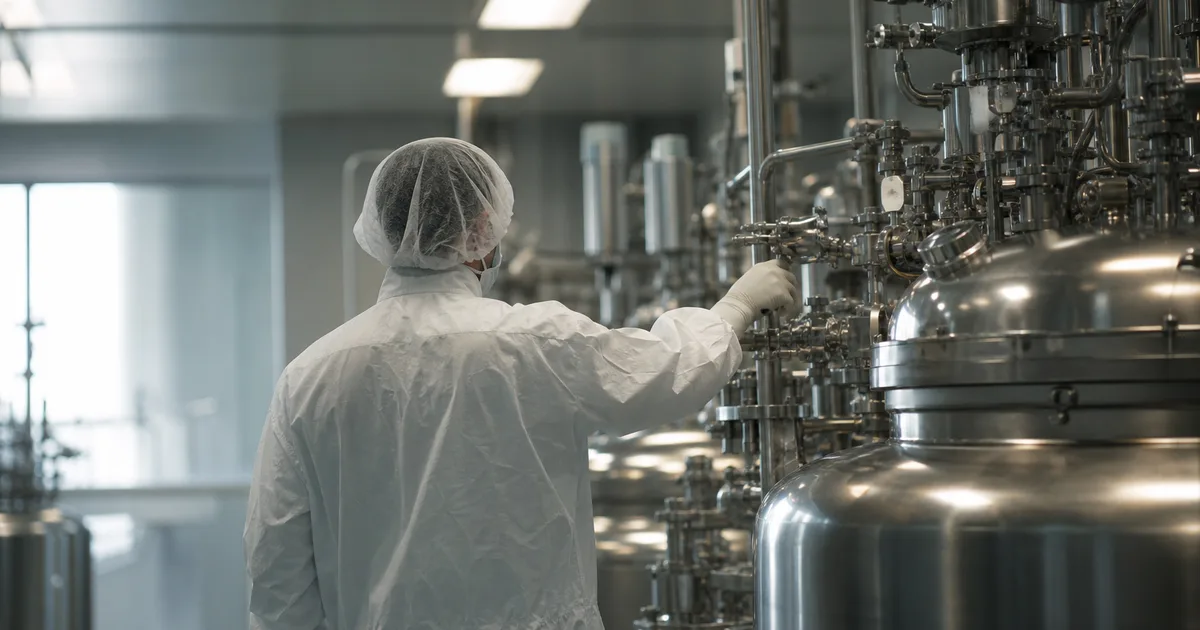
You've spent years in cell culture labs, learned upstream and downstream bioprocessing, maybe even completed a co-op or internship at a pharma company — and now you want a US job that will actually sponsor your visa. You've probably heard that biotech is "good for H-1B" but you're not sure which employers specifically hire international engineers, how to position yourself, or what the OPT-to-H-1B path looks like in manufacturing versus research.
CDMOs — Contract Development and Manufacturing Organizations — are the answer more international engineers should know about. They are the factories of the biologics world, producing clinical and commercial-scale batches of monoclonal antibodies, gene therapies, vaccines, and small-molecule APIs under contract for pharma and biotech companies. Because demand for outsourced biologics manufacturing has grown significantly over the past decade, CDMOs expanded their engineering headcount sharply and continue to hire. They also have consistent, well-established immigration programs. This guide gives you a practical roadmap.
What a biotech process engineer does at a CDMO
At a CDMO, process engineers are divided into a few distinct functions. Understanding which one fits your background is important for job targeting.
Process Development (PD) engineer — Works upstream of manufacturing. Designs and optimizes cell culture processes, fermentation runs, and purification trains (chromatography, filtration, UF/DF). Usually requires deeper science background; PhD or MS with bench experience is common.
Manufacturing engineer / process technician — Executes manufacturing campaigns on the floor. Operates bioreactors, runs batch records under cGMP, troubleshoots deviations. BS-level entry point is common here, especially for engineers with internship experience.
Validation engineer — Qualifies equipment (IQ/OQ/PQ) and validates manufacturing processes. Very documentation-heavy. Strong fit for engineers who like systematic, protocol-driven work.
Technical transfer engineer — Manages the transfer of a client's process from their facility into the CDMO's suites. Requires communication skills as much as technical skills — you are the interface between client and internal ops.
All four roles are well-established H-1B categories. CDMOs that hold large biologics contracts need these engineers and cannot easily hire only domestic candidates; the talent pool is too narrow relative to demand.
The CDMO landscape — who actually hires international engineers
The market has several tiers. Knowing which CDMOs actively sponsor is more valuable than a generic "apply everywhere" strategy.
| CDMO | Scale | Strong suit | Notes for international candidates |
|---|---|---|---|
| Lonza | Large-cap, global | Mammalian cell culture, gene therapy | Consistent H-1B filer; US sites in NH, TX, CA, NJ |
| Catalent (now part of Novo Holdings) | Large-cap | Sterile fill-finish, softgels, biologics | Historically one of the larger H-1B filers in CDMO space |
| Thermo Fisher (Patheon) | Large-cap | Drug substance + drug product | H-1B under Thermo Fisher Scientific entity |
| Fujifilm Diosynth Biotechnologies | Mid-large | Mammalian, microbial, viral vectors | Research Triangle Park NC site is a major hiring hub |
| Samsung Biologics | Large, Korea HQ | Biosimilars, large-scale mAb | US footprint smaller; mostly Korea-based but US positions exist |
| WuXi Biologics | Large, China HQ | mAb, bispecifics | Strong international culture; US hiring at Delaware site |
| AGC Biologics | Mid | Mammalian, microbial | US sites in CO, CA, NC |
| Rentschler Biopharma | Mid (Germany HQ) | Mammalian cell culture | US commercial office; manufacturing Germany-based |
| KBI Biopharma | Mid | Biologics, vaccines | Durham NC hub; JBSA spinout |
For research on H-1B filing history, the DOL LCA disclosure database (available at flcdatacenter.com) lists every LCA filed by employer. You can verify that a specific company has filed LCAs for "biochemical engineer" or "process engineer" roles at a specific wage level. This is the most reliable employer vetting tool available — more accurate than any online list.
See our broader guide on H-1B sponsorship in biotech and life sciences for context on how CDMOs compare to pharma companies and academic medical centers. If your background is more on the small-molecule or API side, the chemical engineer H-1B sponsorship guide covers overlapping employers and hiring trends.
OPT and STEM OPT at a CDMO — the detailed mechanics
If you're on F-1, you'll likely start a CDMO role on OPT before your first H-1B lottery. Here's how the timing works.
Standard 12-month OPT
Your 12-month OPT EAD begins on the start date you chose at your DSO. The 90-day unemployment clock applies — CDMO roles are full-time, but the gap between graduation and your start date counts, so plan your start date accordingly.
24-month STEM OPT extension
Three requirements must be met: (1) your degree is on the DHS STEM OPT designated list — chemical engineering (CIP 14.0702), bioengineering (14.0501), biochemistry (26.0202), and biotechnology (26.1201) all qualify; (2) your employer is enrolled in E-Verify (all major CDMOs are); (3) your employer signs Form I-983, a training plan with learning objectives tied to your degree. For a process engineer, those objectives map to bioprocess scale-up, cGMP documentation, and validation — squarely within a ChE or bioengineering degree scope.
With STEM extension approved you have 36 months of OPT total and two H-1B lottery windows. Cap-gap protects your status if OPT expires before October 1, provided your employer filed a timely H-1B petition. See our guide on employer I-983 training plans for the full compliance walkthrough.
H-1B specialty occupation — how CDMO process engineering qualifies
H-1B requires the role to qualify as a "specialty occupation" under 8 CFR 214.2(h)(4) — a position that normally requires at minimum a US bachelor's degree in a specific field as a minimum entry requirement. Process engineering at a CDMO qualifies clearly; USCIS treats chemical engineering and bioengineering as specialty occupations when the role involves technical design, process characterization, or scale-up work.
The most common RFE issue in biotech petitions is a job description written broadly enough to include non-degreed technician duties. Your employer's immigration counsel should draft duties at the professional/engineer level — "designing and optimizing", "characterizing and validating", "analyzing deviation data to implement CAPA" — not at an operator level. The H-1B Modernization Rule (effective January 17, 2025) codified deference to prior approvals on extensions, which helps engineers seeking their second or third H-1B at the same company.
Step-by-step timeline from graduation to H-1B approval
Here is a realistic sequence for an MS student graduating May 2026 who has a CDMO offer:
- Jan–Apr 2026: Apply to CDMO roles. Target companies with E-Verify enrollment and known H-1B history.
- Apr–May 2026: Accept offer. Work with your DSO to apply for OPT EAD with correct start date.
- June 2026: Start on OPT EAD. Begin tracking I-983 learning objectives with your manager immediately.
- Dec 2026 / Jan 2027: H-1B registration period opens. Confirm your employer registers you — it is easy to fall through the cracks at large companies.
- March 2027: USCIS announces lottery results. If selected, employer files I-129 by June 30.
- Apr–Sep 2027: USCIS processes petition. Premium processing ($2,965 as of March 2026) gives a 15-business-day decision.
- October 1, 2027: H-1B status begins.
- If not selected: Apply for STEM OPT extension to bridge to a second lottery attempt (FY2028 registration).
If two lottery attempts fail, you still have options — EB-2 NIW, O-1 (viable for engineers with publications or patents), or L-1 intracompany transfer if your CDMO has international operations. See H-1B backup plans after the lottery for how to evaluate each path.
Green card path from a CDMO
Most CDMOs sponsor green cards, but timing varies. Ask these three questions before signing an offer:
- When will you file PERM? Some employers file at 12 months; others wait until year two or three. Earlier is critical for Indian and Chinese nationals.
- Which category — EB-2 or EB-3? Most process engineers with an MS or PhD qualify for EB-2. EB-3 can be useful for downgrade strategies if EB-2 dates retrogress.
- Will you file I-140 and I-485 concurrently? If your priority date is current at PERM certification, concurrent filing shortens the timeline significantly.
For Indian nationals the EB-2 backlog can mean a multi-year wait even after I-140 approval. Bioprocess engineers with peer-reviewed publications, conference presentations, or novel process patents may qualify for an EB-2 NIW self-petition — allowing you to file I-140 without employer sponsorship or PERM. Our EB-2 NIW self-petition guide covers the evidence requirements.
What CDMOs look for — positioning your candidacy
Beyond the technical baseline (bioprocess fundamentals, cGMP awareness, DOE/statistical methods), CDMOs look for:
- Scale experience. Any bench-to-pilot or pilot-to-manufacturing scale-up, even in an academic setting, is valuable.
- GMP exposure. An internship in a cGMP environment, or completion of GMP training courses, signals you understand documentation standards.
- Deviation and CAPA. Manufacturing organizations run on deviation investigations and corrective action plans. If you have written any deviation reports or root cause analyses, highlight them prominently.
- Instrumentation. Specific experience with bioreactor control systems (DeltaV, Siemens, PCS7), filtration skids, or chromatography systems (ÄKTA, BioLogic) differentiates you from purely theoretical candidates.
On the visa side, bring up your sponsorship needs proactively — recruiters at large CDMOs have seen dozens of international engineers and the question is whether you are the right candidate, not whether sponsorship is possible. See our guide on how to answer "do you need visa sponsorship" for language that works. Also review ATS resume tips for international students — in biotech manufacturing, spell out acronyms (UF/DF, TFF, CEX, IEX) at first use since ATS parsers may not match abbreviated forms.
Common mistakes that cost international engineers CDMO roles
Applying only to drug discovery roles. Many international biotech graduates target research scientist and drug discovery roles because they seem more prestigious or closer to a PhD-level background. CDMO manufacturing and process engineering roles are often less competitive, pay comparably, and sponsor at equal or higher rates. Expand your search.
Ignoring mid-size CDMOs. Fujifilm Diosynth, KBI Biopharma, AGC Biologics, and similar mid-size shops sponsor H-1B regularly but receive fewer applications from international candidates than Lonza or Catalent. A strong application to a mid-size CDMO often moves faster through the funnel.
Not verifying I-983 capability before signing an offer. Small CDMOs and some startups that have never hired an F-1 student may not know what Form I-983 requires. If your potential employer has no prior I-983 experience, you may end up educating them — which can delay your STEM OPT extension approval or introduce compliance risk. Ask during the offer stage, not after you start.
Waiting until year two to ask about PERM. Priority dates matter enormously for Indian and Chinese nationals. Every month of delay in PERM filing is a month added to your wait. As soon as you are eligible under your employer's policy, ask your immigration attorney or HR contact to begin the PERM advertising and audit file.
Treating the H-1B cap as binary. If you're not selected in one lottery year, you still have options — STEM OPT extension, a second lottery attempt, or alternative visa categories. Many engineers give up after one lottery miss when they had viable paths forward.
Accepting a vague I-983 training plan. USCIS audits STEM OPT I-983 compliance. If your training plan says "will learn manufacturing" without specific learning objectives tied to your degree, you are exposed in an audit. Work with your employer's HR to create a specific, defensible plan.
Frequently asked questions
Do CDMOs regularly sponsor H-1B visas for process engineers?
Yes. The largest CDMOs — Lonza, Catalent, Samsung Biologics, Fujifilm Diosynth, Thermo Fisher Patheon — have consistent H-1B filing histories and well-practiced immigration teams. Mid-size CDMOs sponsor in smaller volume; verify any unfamiliar company in the DOL LCA disclosure database before applying.
Can I work at a CDMO on STEM OPT before my H-1B is approved?
Yes, provided your degree is on the DHS STEM OPT designated list (chemical engineering, bioengineering, and biochemical engineering all qualify) and your employer is enrolled in E-Verify. The employer must sign Form I-983 with specific training objectives tied to your degree. Large CDMOs handle this routinely; confirm with HR before accepting any offer.
What degrees qualify for a CDMO process engineer role under H-1B specialty-occupation rules?
Chemical engineering, biochemical engineering, bioengineering, and biotechnology degrees satisfy USCIS specialty-occupation requirements. A biology or chemistry degree can qualify if paired with directly relevant graduate coursework. A well-drafted petition from an experienced immigration attorney succeeds for these roles at a very high rate.
Which CDMO locations hire the most international engineers?
Major hubs include the New Jersey and Pennsylvania pharma corridor, Research Triangle Park NC, San Diego and the Bay Area, and the greater Boston/Cambridge area. Location matters because DOL prevailing wage levels vary by Metropolitan Statistical Area and affect the wage your employer is required to pay.
How long does the green card path take from a CDMO?
Most CDMOs start PERM after one to two years of employment, filing under EB-2 or EB-3. For Indian and Chinese nationals the priority date backlog can extend the wait significantly. Starting PERM as early as your employer allows is the single most important action you can take — and evaluating a parallel EB-2 NIW self-petition if your research record supports it.
The CDMO sector is one of the more dependable pipelines for international biotech engineers to build a long-term US career — strong technical demand, consistent sponsorship track record, and a clear green card path if you move early on PERM. The key is targeting the right companies, arriving prepared on the visa mechanics, and asking the right questions before you sign the offer.
If you want help identifying specific CDMOs that match your background and have strong H-1B track records, F1Jobs works with biotech and life sciences candidates through every stage of this process.
Frequently asked questions
Do CDMOs regularly sponsor H-1B visas for process engineers?
Yes — the largest CDMOs (Lonza, Catalent, Samsung Biologics, Fujifilm Diosynth, Thermo Fisher Patheon) have consistent H-1B filing histories and are well-practiced at sponsoring engineers with backgrounds in upstream/downstream bioprocessing, cell culture, and purification. Mid-size CDMOs also sponsor but in smaller volume; check the USCIS LCA disclosure data before applying to a company you don't recognize.
Can I work at a CDMO on STEM OPT before my H-1B is approved?
Yes. If your degree qualifies under the DHS STEM OPT list (ChE, bioengineering, chemical engineering, biochemical engineering all qualify), you can work at any CDMO on your standard 12-month OPT and then apply for the 24-month STEM extension. During STEM OPT the employer must sign Form I-983 and provide a formal training plan with learning objectives, which reputable CDMOs are accustomed to doing.
What degrees qualify for a biotech process engineer role at a CDMO under H-1B specialty-occupation rules?
H-1B requires a U.S. bachelor's degree or equivalent in a directly related field. Chemical engineering, biochemical engineering, bioengineering, and biotechnology degrees satisfy USCIS specialty-occupation requirements for process engineering roles. Biology or chemistry degrees can qualify if paired with directly relevant coursework or a master's degree. A well-prepared petition from an experienced immigration attorney almost always succeeds for these roles.
Which CDMO sites and locations hire the most international process engineers?
Major hiring hubs include New Jersey and Pennsylvania (for legacy pharma corridor CDMOs), Research Triangle Park in North Carolina, San Diego and the Bay Area for biologics-focused shops, and Lexington/Hopkinsville Kentucky for large-scale sterile fill-finish. Boston and the greater Cambridge MA corridor also has several biologics CDMOs. Location matters because it affects the LCA prevailing wage level your employer must pay.
How long does it typically take to get a green card from a CDMO employer?
Most CDMO employers sponsor green cards under EB-2 or EB-3 after one to two years of employment. For Indian and Chinese nationals the priority date backlog in EB-2 and EB-3 can be significant — sometimes many years — so the practical path for many engineers from those countries involves requesting early PERM filing, potentially an EB-2 NIW self-petition in parallel, or an EB-1 if you develop an extraordinary publication or patent record. Starting PERM as early as your employer allows is the most important thing you can do.