Electrical Engineer at Space and Satellite Companies: H-1B Sponsorship in the New Space Economy
NewSpace is one of the fastest-hiring sectors for electrical engineers — and many players actively sponsor H-1B and STEM OPT workers.
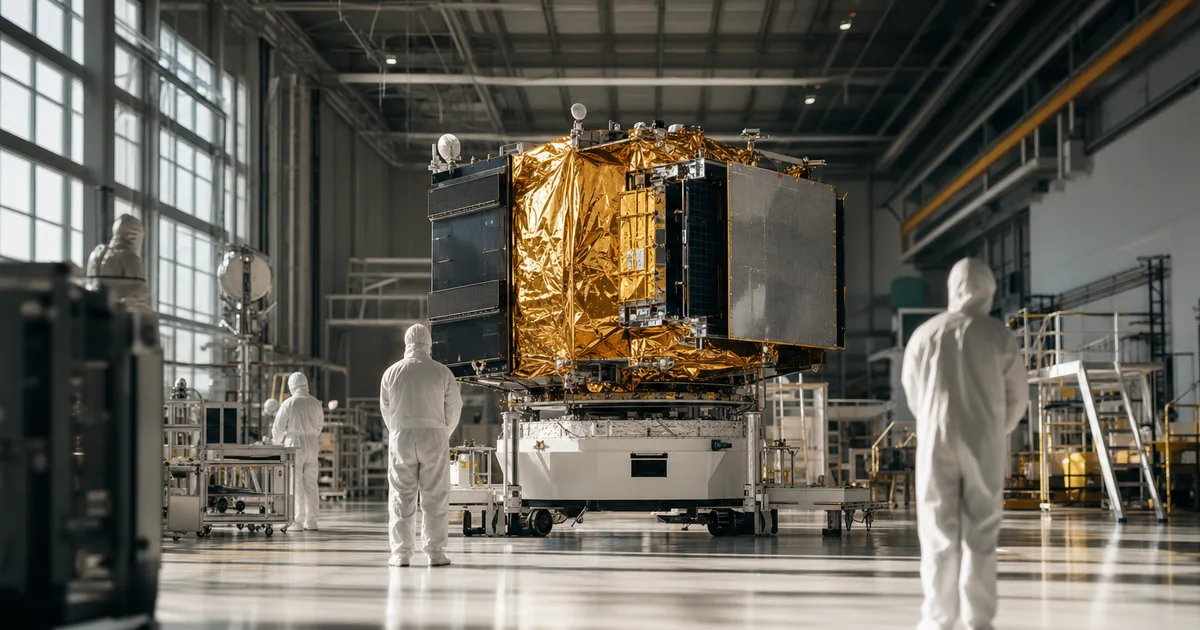
You have an electrical engineering degree, experience with RF systems or power electronics, and a genuine fascination with how satellites stay alive in orbit. You've watched the commercial space industry explode over the last five years and you want in. The question hanging over you — as it does for nearly every international engineer — is whether these companies will actually sponsor you.
The answer is more encouraging than you might expect. Commercial space and satellite is one of the few hardware-heavy industries where demand for qualified EEs still outpaces domestic supply, and where the culture of rapid hiring has forced even mid-sized companies to build out their immigration infrastructure. That said, the visa calculus in this industry is unusually complicated by ITAR, clearance requirements, and the wide variation in sponsorship maturity between a Series A rocket startup and a publicly traded satellite constellation operator. This guide gives you the specifics.
The state of the NewSpace job market for international engineers
Commercial space has bifurcated into two distinct employer segments, and understanding that split determines your strategy.
Large constellation and broadband operators — companies building or operating dozens to thousands of satellites for broadband internet, remote sensing, and IoT connectivity — tend to have dedicated immigration teams, STEM OPT training plans, and active H-1B filing programs. Their engineering headcount runs in the thousands, attrition is real, and they hire year-round rather than in seasonal cohorts.
Deep-space, defense-adjacent, and launch vehicle primes — companies where a meaningful fraction of revenue comes from US government contracts — are more constrained. Government prime contracts often require cleared personnel, and cleared positions require US citizenship or a green card. You will see these postings marked "US Person Required" or "Active TS/SCI required." These are genuinely unavailable to most international engineers and are worth screening out early.
Between those poles sits a large and growing middle: satellite bus manufacturers, propulsion startups, ground software companies, signal processing firms, and test and integration contractors. Many of these companies have enough commercial work to justify non-ITAR engineering teams and are actively competing for EEs with RF, power, or digital systems experience.
ITAR and the "US Person" requirement — what it actually means
ITAR (International Traffic in Arms Regulations), administered by the State Department's Directorate of Defense Trade Controls, controls export of defense articles on the US Munitions List. For engineers, this means that if you are working with ITAR-controlled technical data — launch vehicle propulsion designs, military-grade satellite sensors, certain RF hardware — your employer legally cannot share that data with a non-US Person unless they obtain a license or apply a license exemption.
A "US Person" under ITAR is a US citizen, lawful permanent resident (green card holder), or a person with protected status under the Immigration and Nationality Act. An F-1 OPT worker, H-1B worker, or TN worker is not a US Person under ITAR.
This matters practically because:
- Many space primes have carved their engineering teams into ITAR and non-ITAR pools. You can often work on the non-ITAR side even while on OPT or H-1B.
- Software-defined radios, ground station software, mission planning tools, and commercial remote sensing pipelines are frequently structured to operate outside the ITAR perimeter.
- Some companies will proactively tell you during recruiting which teams are ITAR-constrained. Others won't — ask.
For a deeper look at how ITAR affects your job search, see our guide on aerospace jobs for international students and ITAR.
Which electrical engineering roles actually sponsor visas
Not all EE roles at space companies have the same visa profile. The following table summarizes specializations, their typical ITAR exposure, and their H-1B sponsorship likelihood at commercial satellite companies as of 2026.
| Specialization | ITAR Exposure | H-1B Sponsorship Likelihood | Notes |
|---|---|---|---|
| RF / Microwave Engineer | Medium | High | Depends on whether hardware is commercial vs. defense |
| Power Electronics / EPS | Low–Medium | High | Battery, solar array, and bus power work often commercial |
| FPGA / Embedded Firmware | Low–High | Medium | Depends on payload; ground-side firmware is usually safer |
| Antenna Systems Engineer | Medium | Medium | Phased arrays for commercial broadband are frequently non-ITAR |
| Ground Software / Link Budget | Low | High | Software roles rarely hit ITAR; strong sponsorship record |
| Systems / Mission Assurance | Medium–High | Medium | Broad exposure; depends on program |
| Propulsion Electronics | High | Low | Often defense-adjacent; many positions require US Person |
The roles with the strongest combination of high demand and clear visa pathways are RF, power electronics, and ground/software-adjacent EE roles. These also tend to satisfy the H-1B specialty occupation requirement straightforwardly — USCIS has consistently found that EE roles requiring a bachelor's degree in electrical engineering or a closely related field qualify as specialty occupations.
Navigating OPT and STEM OPT at space companies
If you are finishing a US graduate or undergraduate EE program, OPT is your first work authorization and typically your foot in the door.
Your 12-month OPT window starts when your EAD (Employment Authorization Document) is effective. USCIS requires an application with your DSO well in advance — at least 90 days before your program end date, and the EAD card takes time to arrive. Starting late puts real pressure on the 90-day unemployment clock: you cannot be unemployed for more than a cumulative 90 days during your 12-month OPT period without violating F-1 status.
If your degree is in a STEM field (electrical engineering qualifies under the STEM OPT degree list), you are eligible for a 24-month extension. STEM OPT requires:
- A job offer from an E-Verify enrolled employer
- A signed Form I-983 Training Plan — the employer and you both sign it, describing how the job relates to your STEM degree
- SEVIS reporting every six months
- Your DSO filing the STEM OPT extension before your initial OPT expires
Total authorized work time: up to 36 months (12 + 24). Most H-1B petitions for OPT workers target a start date of October 1 of the cap year, meaning you often need your STEM OPT to cover the gap between your initial OPT expiring and the H-1B start date.
See opt-vs-stem-opt-vs-cpt-2026 for a detailed breakdown of the rules.
H-1B fundamentals for electrical engineers at space companies
An H-1B petition for an EE role at a satellite company follows the standard process: Labor Condition Application filed with the DOL, followed by Form I-129 filed with USCIS. Key facts for 2026:
The LCA and prevailing wage. Your employer files an LCA certifying they will pay at least the prevailing wage for your job location and level. DOL uses four wage levels (Level I through IV). Most EE roles at space companies — where the engineering is specialized and the compensation is competitive — land at Level II or III. The LCA is certified by DOL in roughly seven business days via the FLAG system. Your employer cannot begin the H-1B without it.
The cap lottery. Cap-subject H-1B petitions are subject to the annual lottery (registration period typically in March, lottery results in late March, filing from April 1, start date October 1). For FY2027, registration odds have continued to tighten. See fy2027-h1b-lottery-registration-odds for current data.
Cap exemption via a second employer. Universities and certain nonprofit research organizations are cap-exempt employers. A common strategy for engineers who don't get selected in the lottery is to take a position at a university lab, national lab, or research nonprofit while their commercial space company job search continues. Cap-exempt employers can file an H-1B at any time of year and are not subject to the lottery. See our cap-exempt H-1B guide.
H-1B Modernization Rule (effective January 2025). USCIS codified deference to prior approvals for extensions and transfers, which helps if you transfer from one space company to another after your initial H-1B approval. Specialty occupation analysis has also been refined — the rule confirmed that job duties, not just the job title, determine specialty occupation status, which matters for EE roles that might blend hardware and software work.
The $100K fee proclamation (effective September 2025). This fee applies to new cap-subject H-1B petitions for workers located outside the US at the time of filing. If you are already in the US on OPT or STEM OPT when your employer files, this fee does not apply to you.
Step-by-step timeline from graduation to H-1B at a space company
- Semester before graduation: Apply for OPT EAD through your DSO. Target start date aligned with graduation. Accept your offer.
- Month 1–2 on OPT: Begin work. If your employer is E-Verify enrolled, have them start the STEM OPT Training Plan paperwork immediately — don't wait until month 10.
- Month 2–6 on OPT: Employer's immigration attorney or in-house immigration team prepares H-1B registration for the March lottery window.
- March (year 1): H-1B lottery registration. Your employer pays the $215 registration fee per beneficiary.
- Late March–April (year 1): Lottery selection results posted. If selected, employer begins I-129 petition preparation.
- April 1 (year 1): Earliest date employer can file I-129 for October 1 start.
- May–September (year 1): Maintain STEM OPT work authorization throughout. Do not let your STEM OPT expire before the H-1B start date.
- October 1 (year 1): H-1B begins. You are now in H-1B status.
- If not selected in lottery: Continue on STEM OPT, explore cap-exempt options, or discuss O-1 eligibility with an attorney. Retry the lottery in year 2.
The green card path from a space company
The most common green card path for EEs at space companies is employer-sponsored PERM labor certification leading to an EB-2 (Advanced Degree Professionals) or EB-3 petition. Here is how it works in practice:
PERM. Your employer files a PERM labor certification with DOL demonstrating that no qualified US worker is available for your specific role at the offered wage. This is a procedural requirement, not a test of whether you are a good candidate. PERM applications have been taking 12–24 months in standard processing as of early 2026, or as little as 3–6 months with an audit-free case.
I-140. After PERM approval, your employer files Form I-140 Immigrant Petition for Alien Workers. Premium processing ($2,805 as of early 2026) is available for I-140 and delivers a decision in 15 business days.
Priority date and the backlog. For engineers born in India or China, the EB-2 and EB-3 priority date backlog means years — sometimes many years — of waiting after I-140 approval. The earlier your employer starts PERM, the better. Ask about green card sponsorship during or shortly after your offer negotiation, not years later. See eb2-vs-eb3-green-card-which-category-is-faster for current wait-time analysis.
EB-1A alternative. If you have published research, patents, conference leadership, peer-review experience, or industry awards, you may qualify for an EB-1A (Extraordinary Ability) self-petition — no employer sponsorship required, no PERM required. The space and satellite field has a reasonably active conference and publication culture (IEEE, AIAA, SmallSat), and engineers who have been active in those communities have built real EB-1A cases. See eb1a-vs-eb2-niw-engineers to compare.
EB-2 NIW. For engineers with advanced degrees working on technologies of national importance — commercial satellite communications, GPS/PNT, earth observation — the National Interest Waiver under EB-2 can be a viable self-petition. You must show the field benefits the US and that your contribution is substantial. Space engineers have used this path, particularly those whose work touches connectivity, climate monitoring, or precision agriculture.
Evaluating sponsorship maturity before you accept an offer
Not all space companies are equally capable sponsors. Use these signals to assess how real their immigration infrastructure is before you sign:
- Ask directly: "Has your company sponsored H-1B visas for electrical engineers in the past 12 months?" A specific yes with examples is a good sign. Vague answers about "looking into it" or "planning to hire a law firm" are yellow flags at the offer stage.
- Check public H-1B data. The DOL LCA database and USCIS H-1B employer data hub both publish employer-level data on certified LCAs and H-1B approvals. Companies that have never filed an LCA are unproven sponsors.
- Series and revenue stage matter. Seed and Series A companies may be philosophically willing to sponsor but lack the cash flow to absorb $10,000–$15,000 in legal and filing fees per petition. Series B and later commercial satellite companies generally have the runway to sponsor. See can-this-startup-sponsor-h1b-checklist for a full evaluation checklist.
- Ask about the immigration attorney. A company with an active immigration relationship — a law firm they've worked with for at least two years — is more likely to execute smoothly than one sponsoring for the first time.
For a broader look at H-1B options beyond the big-name employers, see our guide on H-1B sponsorship beyond big tech in 2026.
Semiconductor overlap and adjacent opportunities
A significant share of satellite EE work overlaps with the semiconductor industry — ASICs for radiation-hardened applications, power management ICs, custom RF chipsets. If your job search in pure-play space is running into ITAR walls, pivoting toward the semiconductor suppliers to the space industry often opens up more visa-friendly employers. The CHIPS Act has also generated new domestic fab and design investment. See semiconductor-jobs-h1b-chips-act for that angle.
For general H-1B sponsorship patterns specifically for electrical engineers, see our dedicated guide on electrical engineer H-1B sponsorship in 2026.
Common mistakes
Applying to ITAR-controlled roles without checking. Spend ten minutes reading the job description and company website before applying. "US Person required" is a hard screen — applying anyway wastes your time and the recruiter's. Focus on companies with commercial satellite, broadband, or remote sensing business units where the non-ITAR perimeter is clear.
Assuming the biggest brand name sponsors best. Some large legacy space primes have a very high proportion of government contract work and actively prefer to hire citizens. Mid-market commercial operators and constellation companies often have better OPT/H-1B track records because their business model depends on commercial revenue, not security-cleared programs.
Waiting until month 11 of OPT to start the STEM OPT extension. DSO processing time plus USCIS receipt timing means you need to file early. The 180-day automatic extension of your EAD kicks in only if you file before your current OPT expires. Late filing forfeits the auto-extension.
Not negotiating green card start timing. Your employer's willingness to start PERM during year two of your H-1B (rather than year five) is a genuine financial commitment and often negotiable. If you are from India or China, getting an I-140 approved with an early priority date is worth more than a modest salary bump — discuss it at offer time.
Overestimating the O-1 path without documentation. O-1A (Extraordinary Ability) is a real option for senior engineers with strong publication and patent records, but the bar is higher than most candidates expect. If you do not have peer-reviewed publications, major prizes, or documented critical contributions to high-profile programs, an O-1A petition will likely be denied. Get an honest attorney assessment before betting your timeline on it.
Dismissing the cap-exempt path. National labs (NASA, JPL, national labs affiliated with DOE), university-affiliated research centers, and qualifying nonprofit research organizations are cap-exempt. These employers can file H-1B year-round, outside the lottery. A two-year stint at a national lab that also builds real satellite experience is a legitimate and underused strategy. See cap-exempt healthcare university hospitals h1b for the broader framework.
Frequently asked questions
Can non-US citizens get electrical engineering jobs at space and satellite companies?
Yes. Many commercial space and satellite companies — including publicly traded ones — hire international engineers on OPT, STEM OPT, and H-1B. ITAR restrictions apply to specific hardware programs, but not to all roles. Software-defined satellite platforms, ground software, power electronics, and RF simulation roles frequently do not require a security clearance or US citizenship.
Do space startups actually sponsor H-1B visas for electrical engineers?
Many do. Larger NewSpace companies file H-1B petitions regularly. Smaller seed-stage startups may struggle with the LCA prevailing wage requirements and the legal fees, but Series B and later companies routinely sponsor EEs in specialties like RF, power systems, FPGA, and satellite bus design. Ask your recruiter directly whether the company has sponsored H-1B within the past 12 months.
What is ITAR and how does it affect my job search as an international engineer?
ITAR (International Traffic in Arms Regulations) restricts access to defense-related technical data and hardware. Most export-controlled space programs require engineers to be US citizens or lawful permanent residents. However, commercial satellite internet constellations, civil remote sensing, and software-heavy teams often operate outside the ITAR perimeter. Understanding which part of a company is ITAR-controlled is essential before applying — many large space primes have both ITAR and non-ITAR business units.
Which electrical engineering specializations are most in demand at satellite companies for visa holders?
RF and microwave engineering, power electronics and EPS (electrical power subsystems), FPGA/embedded firmware, ground software and link-budget tools, and antenna systems are all in high demand. These roles appear at both satellite bus manufacturers and commercial constellation operators. They are specialty-occupation roles for H-1B purposes because they typically require a BS or higher in electrical engineering or a closely related field.
Should I target a green card through EB-2 or EB-3 if I work at a space company?
For most electrical engineers from India or China, starting PERM labor certification as early as possible is critical given the EB-2 and EB-3 India backlog. If your employer is willing to file an EB-1A petition based on extraordinary ability, or if you hold a PhD and can self-petition via EB-2 NIW, those paths bypass PERM entirely and cut years off the timeline. Discuss green card strategy with your employer before accepting the offer, not after.
If you want a second set of eyes on your space industry job search strategy — which companies to prioritize, how to handle ITAR screening, and how to time your OPT-to-H-1B transition — F1Jobs works with international engineers on exactly this every week.
Frequently asked questions
Can non-US citizens get electrical engineering jobs at space and satellite companies?
Yes. Many commercial space and satellite companies — including publicly traded ones — hire international engineers on OPT, STEM OPT, and H-1B. ITAR restrictions apply to specific hardware programs, but not to all roles. Software-defined satellite platforms, ground software, power electronics, and RF simulation roles frequently do not require a security clearance or US citizenship.
Do space startups actually sponsor H-1B visas for electrical engineers?
Many do. Larger NewSpace companies file H-1B petitions regularly. Smaller seed-stage startups may struggle with the LCA prevailing wage requirements and the legal fees, but Series B and later companies routinely sponsor EEs in specialties like RF, power systems, FPGA, and satellite bus design. Ask your recruiter directly whether the company has sponsored H-1B within the past 12 months.
What is ITAR and how does it affect my job search as an international engineer?
ITAR (International Traffic in Arms Regulations) restricts access to defense-related technical data and hardware. Most export-controlled space programs require engineers to be US citizens or lawful permanent residents. However, commercial satellite internet constellations, civil remote sensing, and software-heavy teams often operate outside the ITAR perimeter. Understanding which part of a company is ITAR-controlled is essential before applying — many large space primes have both ITAR and non-ITAR business units.
Which electrical engineering specializations are most in demand at satellite companies for visa holders?
RF and microwave engineering, power electronics and EPS (electrical power subsystems), FPGA/embedded firmware, ground software and link-budget tools, and antenna systems are all in high demand. These roles appear at both satellite bus manufacturers and commercial constellation operators. They are specialty-occupation roles for H-1B purposes because they typically require a BS or higher in electrical engineering or a closely related field.
Should I target a green card through EB-2 or EB-3 if I work at a space company?
For most electrical engineers from India or China, starting PERM labor certification as early as possible is critical given the EB-2 and EB-3 India backlog. If your employer is willing to file an EB-1A petition based on extraordinary ability, or if you hold a PhD and can self-petition via EB-2 NIW, those paths bypass PERM entirely and cut years off the timeline. Discuss green card strategy with your employer before accepting the offer, not after.